

Santa Claus, North Pole, H0H 0H0
Dear Santa,
Here it is Christmas Eve, and I know you are busy on your rounds. Last I heard you were just leaving the Sandwich Islands, but that was an hour or so back. Anyway, it is the traditional time for writing letters to Santa, although the old story says that the letter is supposed to be tossed into the fireplace, and as it burns, the pieces will fly up and magically reassemble themselves as they wend their way to the North Pole…
Alas, no fireplace here. But still, you do have a Canadian postal code, and I am pretty sure you will read my letter. There is no point telling you I have been a good girl, I suppose. I have been impatient, as usual, with stupidity and willful ignorance, and I am not very cheerful in the mornings. I have tried to be kind, and thoughtful of others, and sometimes I have succeeded. I think I have done my best, but goodness knows that is not enough.
In years past I used to ask for such gifts as world peace, and an end to starvation, and all manner of things of social justice. I have come to realize, though, that your magic is of a different sort: the kind of magic that works one child, or one adult who believes with the purity of a child, at a time. But it is powerful magic, for all that it is not what I once believed it to be.
If we could each bring the magic of happiness to one person this Christmas, what a transformation there would be in the world! The happiness that comes from being special in someone’s eyes, of being treasured, of being seen for who one is.The magic of simple human fellowship, of the fabled good cheer, of the visions of sugar plums that actually come to be in one’s hand. The magic of the old and familiar stories, and maybe room for some person who is new to our world. The magic that sees the glow of love on someone’s face, and remembers the echoes of love from those departed this earth. The magic that looks and sees not a silly and funny old present, but the look of anticipation on the giver’s face, and the radiance of the joy that elevates the gift to so much more than its prosaic origins.
I believe with all my heart, Santa, and so I guess what I am asking for is a more liberal sprinkling of your magic dust this year. The earth and her children – and we are all her children – need you so very much. I know the supply is not unlimited, but a large sprinkle this year might just help us over the hump. Anyway, so I humbly ask.
There are cookies for you here. I love you. Merry Christmas.
VivianLea
Winter Solstice
I love this day, perhaps in part for the romance of unbroken centuries of denizens of the northern hemisphere celebrating the return of the light. True, it is not as exhilarating as watching the sun rise over jagged mountain peaks on midsummer day, yet the summer solstice is tinged with the faint regret of being at the apex from which the days will slowly but surely become shorter. But now, in mere moments, the days here will begin to lengthen, and the promise of everything to come is very sweet.
I have observed and marked the solstices as long as I can remember in some fashion or another, and I confess to surprise at people who pass them by, unremarked. For thousands of years they have been important celebrations in a myriad of cultures, and I suspect that something is lost to modern life when they are unnoticed. One need not be a follower of paganism, or druidism, or some colourful new age ritualism to appreciate the beauty and symmetry of the solstice.
It would be cliché to say that many modern peoples have lost touch with nature: indeed we are earnestly advised of the ‘nature deficit’ we suffer from. For myself, the hills and valleys, forests and rivers, oceans and expanses of sky form such an integral part of me, of who I am and how my very self has come to be…I observed my fellow citizens out and about today, a gorgeously sunny day, a peach of a day in the rain forest climate that I live in, and they were enjoying the parks and walkways and trails. So maybe, I would say, at least here in this place, we do not suffer from deficit of nature, but from a deficit of wonder…Maybe.
The wonder of axial tilt, that the earth’s magical, invisible axis tilts at an angle to the perpendicular that gives us the seasons of the northern and southern hemispheres, this mysterious, cyclical round of birth, growth, flowering, decaying, and dying…this seems to me to be a source of endless wonder.
That me! I! should be a part of this great cosmic order – perhaps you call it God? I do not think it matters, although in writing that I run the risk of offending some, I suppose. But if I have offended you, I hope you will take a deep breath, and join me in a hymn of praise to axial tilt. To the beauty and sheer magic of being alive on this earth, both its measured order and its chaotic uncertainties, for in this hymn of praise shall we discover what it means to be fully human.
To be fully present to the wonder is to live as humans were meant to live, I think. And by our presence, to turn the wheel one more time to the promise of all that lies ahead. Axial tilt is a wondrous thing.
____ It Spoke _

It…
Spoke
Some
Old
Language
We
Thought…
…
By Laz.F.18/11/2010
Are You Ready for Christmas?
I am thinking deeply and intently on Christmas at the moment, memories of a conversation being stirred up by a chance remark while out shopping: “Are you ready for Christmas?” It was somewhere about December 1st, I believe, when a well-meaning, kindly sort of middle-aged woman asked me that question. The memories I refer to here are of a delicious conversational rant I enjoyed with a friend – oh, probably a few years back. She was irritated at the assumptions implicit in the question, not to mention the ubiquitous banality of it, as was I. As if Christmas consists of X, Y, and Z purchases which will ensure the requisite readiness.
Neither my friend or I celebrate Christmas as Christians, for that is not our religion, which is true for many millions of people. On the other hand, most of the world celebrates some sort of festival at this time of year, and those traditions of the Northern Hemisphere are well-ingrained for many of us. So while it is perhaps a touch insensitive to blithely assume all your fellow shoppers do celebrate Christmas, I am not about to embark on a deconstruction of the politically correct holiday address. Call it Christmas, call it what you will, we set aside a day at the beginning of the winter season to celebrate, and that is a beautiful thing.
What I was shopping for on that day was lined paper, and you, my imaginary friend, will be pleased to know that I am sitting in my favourite 1940s library chair writing on said paper, whilst sipping a cup of Kick Ass coffee. Cogitating on Christmas. That shall be my last purchase other than food necessities until January, for I cannot bear to be a part of the dysfunctional ritual shopping farce that Christmas has apparently become for some. I am curious (and ever hopeful) to see if more people shall disconnect themselves this year. It simply cannot be bought, the magic and charm of the season.
I was, I think, five years old when my cousin told me that there was no such being as Santa, but I never really believed her, for I could see the spirit of Santa Claus in everyone and everything. The bright lights and beautiful decorations, the special foods and feasting, the treats, the happy, smiling people everywhere and many visitors, the ordinary cares of the world set aside for a few days. Silver-shining blessed moments such as these could only be invoked by magic, I reasoned then and still do.
Most of my Christmases have been spent with the family I grew up with, though not all for we live far apart. But those moments preserved as memories of the very best of times mysteriously bind us together in ways that cannot be reckoned logically. A couple of gifts stand out: a big box of second-hand books, one year (we are all book lovers), and another – a pony. The entire neighbourhood came out on their doorsteps on Christmas Day to clap and cheer as I rode my pony through the gently falling snow. What a picture postcard scene to hold fast to my heart: my family, my friends, my community showing their joy at my joy.
There is much more I want to tell you, my imaginary friend – yes, it will be a book, and it will be ready next year about this time, I think. I am hoping you will forget this, though, as they are likely to be next year’s gifts. And I am not telling you what this year’s gifts are, although I have been working on them for months. When I finish this I shall start on making some special cakes for friends and family…Christmas here will be full of simple feasts and simple pleasures and simple good cheer. No frantic shopping required.
Maybe I shall end here with a vignette of Rudolph, who is about fifty-six years old – older than me, anyway!
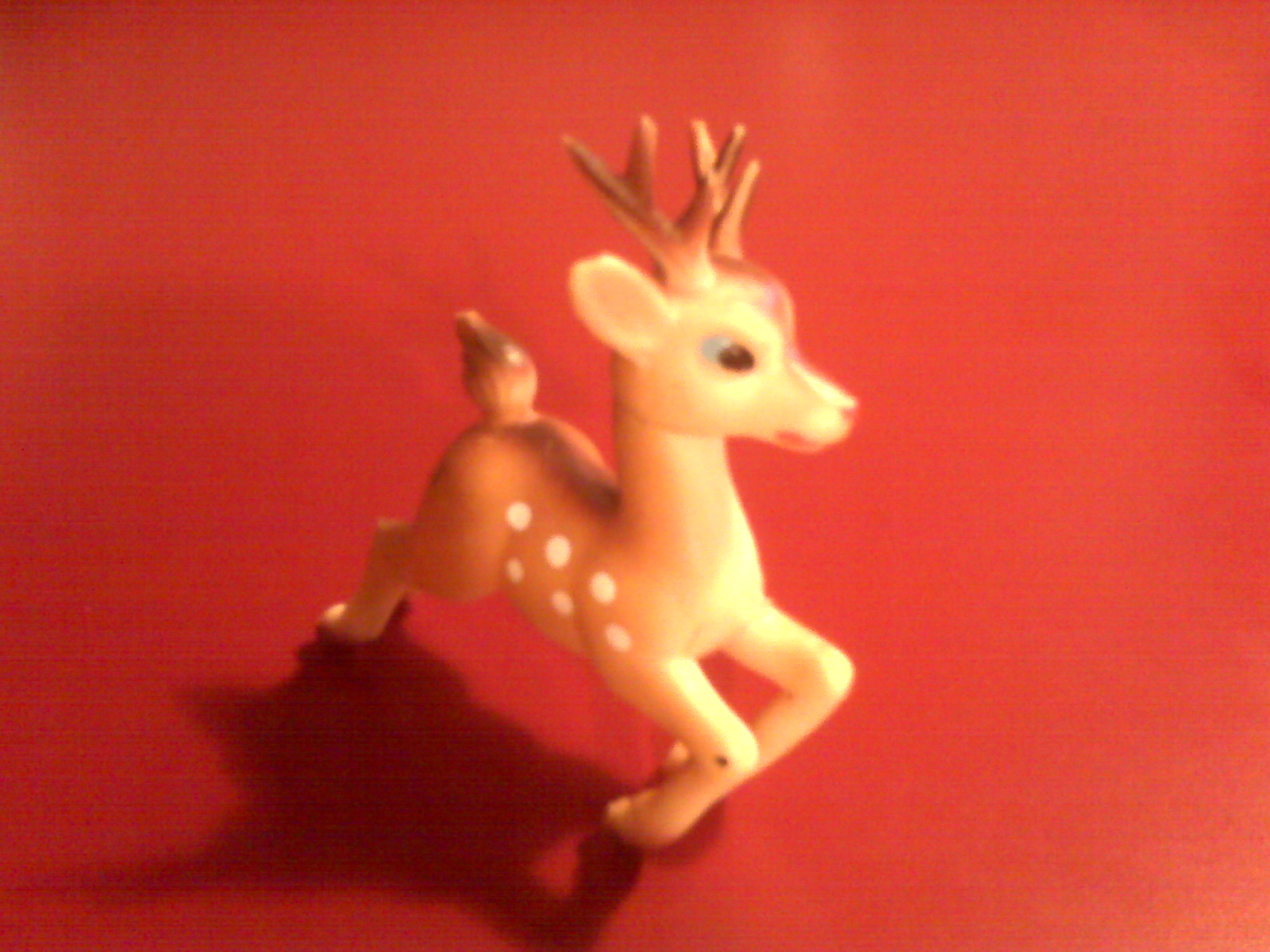
Originally Rudolph pranced about in the snow (oh, that marvelous fake snow that looked so real!) with his team mates and sleigh and Santa, all encased in a golden sort of cage. It was a table ornament, I guess, and I loved it with a fierceness that still surprises me. Sadly, a few years ago the thing pretty much disintegrated, and my mommy gave me Rudolph as a keepsake. You know, when I look at him I remember just how he used to look, proudly leading his sleigh. Never shall that vision tarnish, for it is my symbol of everything Christmas.
Joy. Goodwill. Peace on Earth.
Yes, I am ready for Christmas.
Buy Nothing Day
Today is Buy Nothing Day, as brought to you by Adbusters for the last twenty-five years, apparently. I haven’t been aware of the campaign for that long and I am not writing here about Adbusters in particular, but about what this meme has meant to me. For I do remember that the first Buy Nothing Day I can recall found me shopping. I can’t remember the details, but I am pretty sure I went grocery shopping which I have a tendency to put off until desperate – out of food, or out of coffee, more likely.
I suppose I was already absorbing the lesson of how dependant we North Americans are, all but a very few of us in any event – whether we live in big cities, small towns, or sleepy rural villages – most of us depend on the work of thousands of people to sustain us: to feed and clothe us, to keep us warm, to transport us around. Should any of these systems fail we are in trouble, and that is rather contrary to the picture we like to paint of ourselves as free citizens exercising a choice. We consume because we have to, so the idea of Buy Nothing Day is an exercise – for a day – of examining what and when and how and why we consume, and I think there are some terribly interesting things to be learned from that.
Perhaps Buy Nothing Day has been misunderstood as a kind of earnest, lefty rant about consumerism, or maybe even conjures up the crusty old Scrooge or some such image. So I want to be very clear that I am writing about my experiences and what I have learned. I haven’t much interest in writing prescriptions for anyone else, save this: that in the quest for the ‘good life’ it is worth examining everything, I think. (I must insert here that I am irritated to have run out of lined paper to write my first draft on, and have resorted to the keyboard. I really do observe Buy Nothing Day, these days!)
I will take you back to when this began in earnest for me: I was running a business, a rather successful business with thirty full-time employees and usually another dozen or so part-time, and I simply couldn’t keep up with the demand from consumers. I did not see how I could logically manage more employees, more customers, more, more, more – that is, not if I wished to run a small business that brought me a comfortable living. My business consultant thought I should sell franchises, but that didn’t appeal: I did not have it in mind to be an executive, but a small business owner doing the things I loved. I set about creating a business that sustained a steady range of income, that neither grew too much, nor contracted too much, and that proved much more interesting to manage and required me to be much more creative in my planning too.
It was inevitable that I would look at my personal life too: I think in those days I spent a fair bit on clothes, and shoes, and cosmetics, and books and CDs and going out for brunch, lunch, dinner for lack of time, often, and I also had a small house. I loved the small house and wasn’t willing to move, so managing stuff took up time, time I resented. It was easier to stop buying some of the stuff in the first place, so I did. Everything I decided to stop buying at first was the obvious stuff; obvious because I didn’t miss it and nothing was missing in my life: just the opposite, I had more time and I wasn’t managing stuff. Naturally I had more money: money that went into a savings account, and money that I could be generous with when it came to charitable donations. That giving gave me a lot of pleasure, I found.
Of course, I am trying to compress here a kind of ongoing game I played for more than 15 years. Did I need it? Did I love it? These were always the criteria, and it is now an absolute reflex, and ingrained habit for me to ask of myself when buying pretty much anything. These days it is out of necessity that my purchasing is restricted – as is true for so very many of us – but necessity does not feel harder than choosing, paradoxically. True, there are things I must give up in order to drink the fair trade, organic, bird-friendly coffee that I love – Kick Ass Roast from Kicking Horse Coffee – but I love the coffee. It is a morning ritual to prepare it just so, and to spend an hour or so enjoying the flavour and aroma and terroir of the bean. More importantly, it is an integral part of my day that brings me immense pleasure and satisfaction. In the main, that has become the ethos of Buy Nothing Day for me: that I do less, and have less, but what I have and do is so much more intensely pleasurable and joy-constructed.
We are not what we buy, but what we love. No matter what the marketers tell us, we cannot be defined by our possessions. We cannot be defined by which of the colas we drink, and you know who they are, I refuse to name them, and I do not drink them – or what laptop we purchase or what cell phone we have. Neither by movies we might care to watch, or books we read, or what brand we purchase. For me, there are ‘right’ choices and ‘not right’ choices, and those choices might be different for you. But if all each of us does is to make the choice that feels good and right to us, that brings us pleasure or brings another pleasure, then we have set out upon our true path to a life of meaning. I think Buy Nothing Day is worth thinking about, and talking about, and reflecting upon for these reasons. We can awake to a sense of both purpose and pleasure in the day ahead of us, as well as constructing our days to bring us joy. I suspect that might mean less is more, for some things, and more, much more, of other things. But I am pretty sure we cannot get there without some deep reflection on the ways we spent our money and the things we do to get that money, and of course, all the things that money cannot buy.
What Dreams May Come?
I have unabashedly borrowed my title from the movie of that name; the film had some delightful scenes of the afterlife, imagined. My favourite was the scene of walking through a mountain meadow, as paint splooshed up from the flowers – but here, you can take that journey yourself, briefly.
Our hero finds himself in heaven, and his guide informs him that his world is anything he can imagine. Which is true, really, in some basic way in our own world, is it not?
I find myself wondering about dreams that die, or are forgotten or laid aside, dreams that can’t be resurrected, dreams that just refuse to come true. For there seems to be essentially two kinds of people in my life: those that have realized their dreams, but now think they are a sham, and those that have come to realize that perhaps they did not dream largely enough. I expect there are more variations on the theme, though maybe my imagination is not up to the task. Here are those who have married and had children (or not), built homes and careers and friends and lifestyles and accoutrement, and now appear to be bored and tired of it all and unwilling to build new dreams. These people say that this is a function of getting older and wiser: you know, you just can’t have it all. Never the less, there is something weary and dispiriting and soul-destroying in that message.
The most interesting people seem to recognize when it is time to let a dream go and to dream a new one, but not at all in the practical sense of giving in, dreaming smaller, or limiting the imagination – just the opposite. That perhaps their original dreams simply weren’t big enough, or grand enough, or imaginative enough, that their dreams didn’t, and don’t measure up to the kind of person they were and are. There is an old saying: Be careful what you wish for. What you wish and dream may come to define you in ways you cannot foretell, I believe, whether or not they come to be.
Me, I have lived with a dream that has been present for as long as I can remember, and I have been ruminating on giving it up. In one sense I am very fortunate; none of my dreams have been very conventional, that is, what my friends and peers and population cohort have been dreaming, so I have always had to explain my dreams to others. Why I dream of this, and not that…I have never dreamed of having children, for example, and I do not have them; that particular choice used to engender intense questioning and accusations of selfishness. I suspect that this scrutiny led me to very sure of my dreams: I had examined them, after all.
Everyone has had dreams that did not come to fulfillment, of course, although for me it is harder to acknowledge that most of my dreams did come true…and so, here I am, not done dreaming, but neither satisfied. I must further illuminate this: I hope and believe it is the true human condition to never be satisfied, although this has nothing to do with material things and everything to do with things of the heart and spirit. And also, I do not berate myself or have many regrets, only one sincere regret of a hurtful thing I did that I would erase, if I could. No, it is not about failure, it is about choosing the dreams that will define me for the next few decades, and so, I think, one closely held dream has to go, for I am becoming sure that I would not like the way it might define me.
I am not up to the task, I fear, but let me limn a new outline of what dreams may come for me. I should like to walk through painted landscapes of beauty. I should like to have had some part in creating that beauty, with hands and heart and eyes and pen. I should like to cook delightful meals for friends and family, and make new friends, many new friends. I should like to inspire others to dream of their true calling, and how that might invigorate both work and play and even the ordinary, prosaic tasks of the day. (It could also invigorate politics, banking, and neighbourhoods, but that is a subject for another day.)
I should like to imagine the world the way I wish it to be.
It is no small task, my imaginary friend, I know. For the constant drone of the unhappy and deadened spirits in the background take both largeness and loudness to overcome, and they must be overcome, lest we slip into a world of their making, horror of horrors. For their world is outlined by such words and phrases as practical, common sense, not possible, not sensible, idle dreamers. Not idle, we dreamers. We are busy making the world.
The Dignity of her Death
Dignity is an echo in the heartbeat of the people
~OccupyWallStreet
Occupy Vancouver (British Columbia) has been much in the news of late; first, a mayoral candidate succeeded in making the encampment a municipal election issue for the city. Then an unfortunate person who drug overdosed (now recovering) in the camp, with the mostly predictable and pointless media response. Last Saturday, a young woman died at the site, apparently of an overdose, although the cause of death is not yet official. Mayor Gregor Robertson called for the camp to be dismantled, and the city is at this moment applying for a Supreme Court injunction to move out the tents. The death of the young woman has become a platform for people to rant about their opposition to Occupy Vancouver, a talking point for opportunistic politicians, a sound bite for the news.
The Tyee published a piece by David P. Ball today; you can read it here. The family and friends of the young woman don’t appreciate the fact of her death being used in this brutally insensitive fashion, and the Tyee piece is a respectful response, I believe. But I must draw your attention to some distasteful comments following the article also. I shall not deign to mention the ‘names’ they post under, as they shall be self-evident. It is these actions and comments I want to speak to, however.
For this is not a matter for politicking, or soap boxes, and most assuredly it is not a matter of ‘right’ or ‘left’, or any other political/philosophical orientation. It is a matter of a death, and how we respond to a death. We do not know her, we the public, but surely our first feeling must be sorrow. A range of complicated emotions might ensue – pity, fear, anger – but these are not the emotions one hears in these actions and comments. One hears the manic voices of those determined to impress their views upon others; the robotic voice of uniformity and conformity; the voice of corporate attack dogs. Perhaps I should say this is what I hear, in the metaphoric sense – a kind of horror image of a mechanistic world view arises – the film Metropolis is brought to mind.
And so I turn to you, my imaginary friend – and I shall ever after call Ashlie one of my imaginary friends – someone I would have loved to have known. Someone who seems to have been quirky, and interesting, and rather beautiful and whose loss I regret. Someone whose loss I mourn, for it is the natural human response. I cannot erase those hurtful, hypocritical, awful words and deeds, but I can assert that the natural human response still resides in some of us and we shall not forget the dignity of all humans, even in their death.
Her name was Ashlie Gough.
The Road Curves
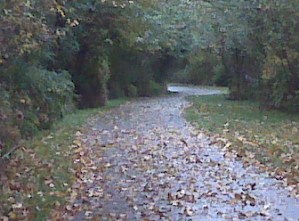
What’s around the corner?
I never fail to be captured by this little piece of path that I walk a couple of times a week, that I have walked for more years than I can remember, that I have photographed in every season and light conditions, but whose essential elements I have yet to catch satisfactorily in a picture. This image comes courtesy of my cell phone, taken today, its’ only purpose to introduce the immediacy of the visual, my visual, today.
This view, this vignette is so familiar, my delight in it quite visceral. But I have come to recognize that is serves as some kind of metaphor for me: no doubt that is why I keep trying to capture some amorphous quality that simply doesn’t appear in the photographs. Much as I have photographed the scene over the course of years, I embark now on the idea of painting the word picture that illuminates the metaphor. I do not know how long this shall take, but since I love the tradition of a year and a day, this shall be my striving: to write, over the course of the next year and the one day, of what it means.
I do not mean to be mysterious, my imaginary friend. Have patience: the world does not much encourage delving deeply into the qualities that inspire and inform our very humanity, but of a certainty that means nothing. You have been chosen as my imaginary friend precisely for this reason, that we should carry out the quest together. I shall only ask you to consider this: what fills you with wonder?
Occupy: a conversation
Sean Hannity calls Occupy Wall Street protesters traitors. A US Marine (in uniform, although perhaps a former marine, not important) standing with the protesters on Wall Street, when asked how he would respond to Hannity says: “I’d tell him to fuck off”. CBC Television interviews Chris Hedges on his view of Occupy Wall Street, and ‘reporter’ Kevin O’Leary asks him if he is a “nut bar”. Hedges tells CBC at the end of the interview that he won’t be interviewed by them again. Thus is the public discourse on matters political framed; few sane people wish to participate, and only the bravest, stupidest, or those being paid in one way or another do so. Meanwhile, the world faces economic volatility – you have to love that phrase – massive uncertainties about what climate change will bring to pass, horrific images from around the globe of bloodshed and starvation, fears about energy dependency and peak oil, and an ever increasing population of people feeling totally demoralized.
I heard that word ‘demoralized’ used as a descriptive of how the western world – or the 99%, if you like – is feeling, and it struck a deep chord in me. My feelings of inchoate helplessness have certainly grown in recent months, and deeply thoughtful conversations with friends, and acquaintances, and anybody who cares to converse in that fashion revealed this common thread. Not despairing, not depressed or filled with rage. People simply struck dumb by the brute ugliness of what leaders, opinion makers, and the media think it worthwhile to speak about while we in the millions are homeless, jobless, and otherwise deeply suffering.
I believe if there is any one thing that Occupy Wall Street could be said to be about, perhaps it is this refusal to accept walking through life demoralized. If the public conversation continues to be hate-filled sound bites, empty rhetoric, or pithy, pointless tweets, the private conversation has never the less been energized and emancipated. The use of the word emancipated is purposeful: it appears that this movement, or shift [insert your characterization of choice here] has indeed engendered a freedom to talk about how things ought to be.
I have no shortage of opinions on how things ought to be, but that is not the point here. Nor are your opinions, my imaginary friend. No, the point is this: that every meaningful conversation – conversation, debate, consideration of alternative views, sharing of experiences, and questioning of other’s experiences – is movement in the direction of how things ought to be. We forget, maybe, that this has been the time-honoured way of democracy right up to the very recent past. How shall we live? How shall we do business? How shall we govern ourselves? Yes, these are huge questions, and yet we have traditionally answered them as a body of one kind or another, as a group, as a community, a society.
It strikes me that how to fit the movement of Occupy Wall Street into the existing framework of bought media, partisan politics, or community cronyism is a backwards take. The pressing, crucial, larger idea is to engineer these systems to facilitate the conversations. Although ‘wake-up’ has been used as a catchphrase by protesters, it might serve as the appropriate metaphor, because there is no denying that something is stirring up the hearts and minds and spirits of people. I do not think it will be possible to go back to the demoralized world of even a few weeks ago. It bears repeating that democracy is what we wish back: the participation of all citizens in shaping and defining how things ought to be.
 Me, and my imaginary friend