yes, my days are full of colour! Thank you, Laz.

This
Day
Full
Of
Color,
Never
Dulls
________
By Laz.F.23/9/2010
yes, my days are full of colour! Thank you, Laz.
This
Day
Full
Of
Color,
Never
Dulls
________
By Laz.F.23/9/2010
I leave in few days for a brand new life, and a brand new business. I will keep you all updated about my adventure, but today I want to share some art that my friend Naomi Tewinkel created for me. A small word of explanation: my nickname is moo, which is actually short for lovesick moo, it’s a long story. (Did I just tell that to the world, my imaginary friend?)
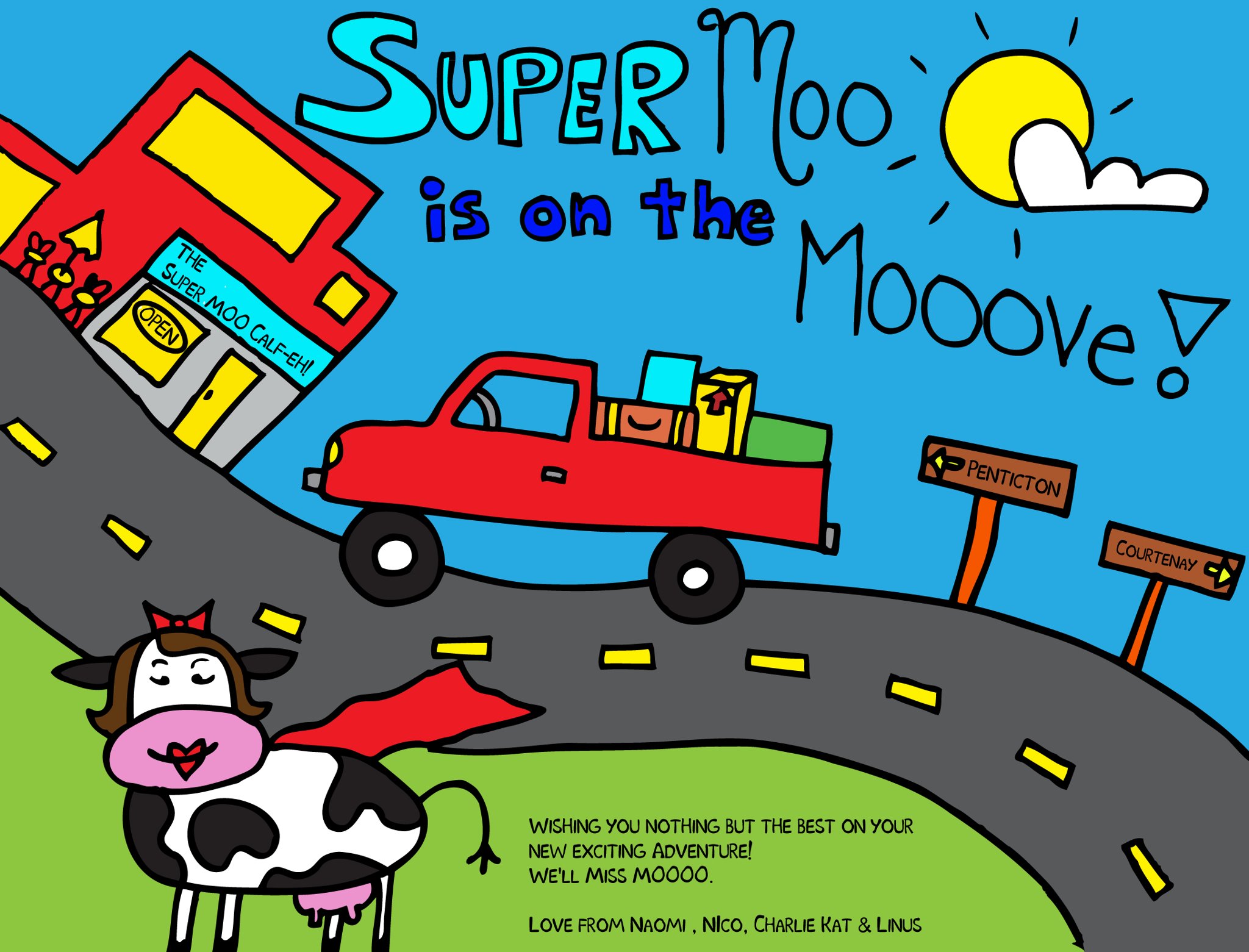
You can find more of Naomi’s whimsical art here
I think you will love it as much as I do, for her beautiful heart and soul shine in everything she does. Now off I go, not looking back, but remembering every single one of you that I shall not see so often.

I’ve never held a hummingbird in my hand. And it’s not like I haven’t wanted to. My heart swells to overflowing while imagining the feeling of a tiny bird body thrumming at a hundred miles an hour against fingers and palm. It would be rather like capturing a giant feathered bumblebee.
I’ve always adored hummingbirds – and fed them wherever I have lived. They were especially abundant in the high desert of New Mexico, though the Rufous was by far the most aggressive and prolific, and would chase away any Ruby Throated or frankly any gossamer winged creature that dared compete with their man-made nectar. The sound of their wings was distinctive, and amplified like a nest of mad hornets racing around trying to rebuild a damaged hive.
In our house overlooking the Sangre de Cristo mountains was a greenhouse just outside the kitchen. Occasionally a hummingbird would…
View original post 230 more words
Poetry remembers that language is shaped air; it remembers ashes to ashes, dust to dust, wind to wind; it knows we don’t own what we know.It knows the world is, after all, unnameable, so it listens hard before it speaks, and wraps that listening into the linguistic act. ~ Don McKay
I came across this lovely evocation in Robert Bringhurst’s book “Everywhere Being is Dancing”. I find something completely profound in this little snippet…Bringhurst goes on to write about it for several hundred more pages, bringing in other themes and uniting the whole in quite a staggering way. Meanwhile, I remain immersed in the idea of wrapping listening into language…
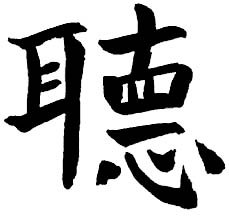 And here is the Chinese character for listening: on the left, the sign for ears, while on the right, from top to bottom, the signs for eyes, full attention, and heart. What a beautiful visual metaphor for the engagement of listening.
And that is what I have been doing, my imaginary friend, listening to the sounds of the world and pondering the ineffable beauties of poetry.
Yes, wouldn’t this be nice? A convenient spray pump to ease the tangles …thank you, Laz.
Sprays
No
More
Tangles,
On
Life
……………….
By Laz.F.2/11/2010
It would seem to be sacrilege to add words here…This is so lovely and carries an ocean of meaning.
I cannot shake the idea that this day has some magic, somehow. Of course it is a calendar correction, and Wikipedia has a fine article on that. Doubtless you will have been inundated with stories of the folklore of the day as well. Still, a day that exists only once every four years… Not quite exactly, but do read Wikipedia for details.
So here we are, and what is this magic, anyway? I want to dig down, deep down into this feeling; something like being on a cusp. Or perhaps merely the anticipation of Spring? Sigh. By now you will be asking yourself, my imaginary friend, just why you are reading this stream of consciousness.
It has to do, I think, with the idea of reviving a feeling of wonder in the ordinary and the prosaic. The way we used to come together, in the community sense, merely to mark in some shared way all manner of things. The first of May. The harvest. The turning of the tides… These ideas changed over the course of centuries, naturally, though they seem almost ghostly remnants, now.
Well, here is my insignificant contribution to marking this day, this year. Because the magic I believe in is that spark that yearns for connection. Beyond the connection of family and friends, the connection that extends to town, or city, or village, to nation, to culture. That we share some simple experiences, and because we share them, we shall make note.
Signs of Spring everywhere: buds fat on the forsythia, peonies pushing up, crocuses beginning to bloom, and although a glorious day of spring-like weather has yielded to a miserable, chill, and windy day with wet snow flurries predicted – yet, my mood turns to Spring, maybe. A ghostly fragment of a poem keeps coming to mind:
Something’s up, young Hank
Something green
Is beginning to push its way
through the crap and crud of reality…
My apologies to the author, who is, I think, Adela Rogers St John. This, a fragment typed onto a note on a fridge door a long time ago, echoes in my memory but perhaps imperfectly. There is a story there, for certain, but not today, and I write not of the weather today except metaphorically.
I have been deep in thought these past weeks, deep in reading learned treatises, deep in attempting to answer my burning question. The lack of being able to articulate that burning question precisely has no doubt hampered my quest for the answers, but I believe the essence of it is this: Why are humans so wary of those who are different? I am aware of those who posit this as an evolutionary advantage, a necessity of tribal life: this person is the tribe, that person is not and distinguishing the difference between the two might well have marked the difference between life and death. So perhaps this question is not really more central to our times than those more savage past times. Do we have more freedom, or less, in the sense of our social structures as compared to, say, a feudal society? Not a question that can answered definitively. Many historians assert, for example, that a feudal peasant would have worked less hours than the average Canadian or American of today – this is in contrast to the popularly held view, of course.
In any event, I can only ask the question from my perspective of my time on earth, and it seems to me that the parameters of social behaviour have become much narrower, more tight-fitting, and for me, they begin to chafe. Not just for me though: in my local paper last week a woman wrote in to say how much she had enjoyed a night out dancing, which was however marred by the sheer number of strangers who had to come and tell her that it was great to see her dancing “at her age.” I do not know the woman, or what her age is, but I can feel for her. Sometimes I would like to jump and skip and express my delight and exuberance but I find it provokes reaction. Speaking directly provokes reaction. Having a third drink provokes reaction. Asking for seconds provokes reaction. Anyway, my imaginary friend, it’s not so much that I don’t understand these little rules of social decorum as that I don’t care to be characterized or guided by them. How sad that joy and exuberance and pleasure in being alive should place one beyond the pale, so to speak. Or at any rate, out of the ordinary.
This cookie-cutter life, this idea that we ought be pleased by the same things, enjoy the same entertainment (but not too exuberantly), share the same goals in life (marriage, children, and accumulation), and talk only of the ordinary and the superficial; why, perhaps it was unleashed upon us by mass marketing and advertising, but it remains with us because we simply cannot face our fears. That may or may not be true for us as individuals, but it is most certainly true of our socially-constructed worlds. I see no choice but to resist the fear. Dance a jig. Say shit very loudly when warranted, and when you mean shit, not manure. Live your joy when you feel it. Maybe the crap and crud of reality shall become the garden’s compost.
I somewhat reluctantly put pen to paper today. Reluctantly, because I know that what I wish to write about has no cachet, not even a hint of the flavour of the moment. Then again, it has been ever thus, so why not plunge in?
Although I shall invoke the Occupy movement, today’s topic is only tangentially related. The Occupy campaigns as they play out across cities, and indeed, countries serve to embody the polarization that seems likely to destroy the very fabric of western society. Is that melodramatic? Perhaps I should colour in that stark outline.
I watched a couple of hours of live-streaming video of Occupy Oakland ‘protesters’ a few nights ago, and I was troubled. I was even more troubled by media reporting on the event, however, which was often sensationalistic, one-sided, un-nuanced, and untruthful. As an example of a direct lie, some media reported that “protesters stormed the YMCA”, which is not what happened. The door to the YMCA was opened by someone to allow the protesters in – for whatever reason – and there are a number of videos posted to YouTube that show this. For sensationalism, we have only to look at the pictures of the American flag being set alight over and over again. At least one blogger reporting on this incident who claimed to have knowledge of the perpetrator suggested that mental health may have been an issue: here is an example of nuance. Horror! Sacrilege! The very symbol of freedom desecrated! The people watching at home declare their outrage and even the supporters of Occupy decry the violence of ‘protesters’: this is one-sided.
I cannot pretend to have an expert opinion on what happened, but I do have a considered opinion. By that I mean I watched live-stream and main stream video, read bloggers and paid columnists, talked to people who were there, and listened to the opinions of others. Was there violence? Undoubtedly. There was violence on the part of those in uniform, and on the part of those styled as ‘protesters’. Again, I do not claim the definitive version, but the violence of the protesters seemed related to property. In any case, the violence of the police seemed much the preponderance.
How did we get here, my imaginary friend? To the state where everything is presented as black/white, either/or, this/that – but never the other? At the point where four hundred people are arrested, and a thirty or sixty-second sound bite serves to sum it up? Where lies outweigh the truth, and the honeyed voices of carefully made-up news anchors instruct us what to believe? And shriller and shriller becomes the other side – in desperation?
Here is another aspect for your consideration: Occupy again, but this time at the encampment at McPherson Square, DC. Watch carefully, watch twice even.
How on earth, in a free and democratic society, did we come to believe that police officers should do their job in such a fashion? Without even speaking to the man arrested, using the taser as casually as blowing one’s nose, faces devoid of expression, or animation, or indeed, of human-ness.
All democracies are about the conversation: “How shall we live?” Absolutely, categorically, this conversation must happen for societies to grow and flourish. This is the crux, right here. The question is not whether we condone violence: we do not, most of us. The question is not whether the police had a right or reason to arrest the lone protester; the question is why their behaviour shows no respect, no human values what so ever. The question is not whether you support the Occupy movement or no. The question is “how shall we live?”, and those who avoid the questions and the conversation are supporting the violence and dysfunction of our society. The rights and freedoms of democracy that we have taken for granted – at least in my lifetime – means that each of us has an array of choices. What underpins the choices, the daily bread of existence, are the institutions of government, of justice, of public education, of taxation, of all the things devoted to the common wheal that we citizens of democracies have fashioned over the course of time. There is no private good without the common wheal.
Make no mistake, I am not making a statement of ideology here, but a statement of simple practicality: regardless of what choices you make and how you choose to live personally, these choices will disappear, quite literally, without the framework of our institutions. So how we got here is perhaps a sociological, psychological, and political question of great complexity, but how to move forward is simpler. As simple as recognizing that good conversations have an equal mixture of speaking and listening, with the odd pause for reflection. As simple as recognizing that we must begin to inform ourselves, not expect to be informed. And as simple as recognizing that opting out of the conversation, means at this moment, supporting much that is wrong and shameful.
It was time to end this long ago, perhaps, but I cannot help reflecting on what the iconic Canadian artist Alex Colville said: “I suspect that what troubles people about my work, in which they find mystery and intrigue, may well be the idea that ordinary things are important.” The ordinary things, the geography of our daily lives and our nations, the taken-for-granted beauty of freedom and democracy – we cannot celebrate these without recognizing the necessity of contributing to their flourishing. It is possible to consider the people of the Occupy movement as participants in the democratic process, rather than simply ‘protesters’. Their impassioned plea to redress the wrongs and shames of our nations in contrast to the deadened, impassive faces of the police arresting them shows the chasm we must bridge. Shall we choose to participate, or to invoke more violence by our silence?
Ah yes, they were strong elder women. They had to be, you know, life was hard, then. Quick-tempered they were, and tongues that could wound very deeply. Then there was another generation of mostly girls (the story of the boys is their own to tell), and they too were ‘strong’. And that generation of beautiful women raised yet another generation of ‘strong’ girls.
Being ‘strong’ had different connotations in different generations, but always it meant being the perfect princess. Smile! Work hard. When your family comes to visit, show them you are in control by being the perfect hostess with the perfect home and perfect children, naturally. Feelings are irrelevant, not important, and must be ground down at any cost. It is the appearance of things that counts, and smile, smile for the camera. For if the camera records a happy, smiling family, then it is a happy, smiling family, right?
Sadness, fear, or anxiety are not manifestations of the perfect princess, and therefore will not be expressed, upon pain of punishment. Sometimes physical punishment, but more often shaming: look at her, she is being sad and clearly there is no reason to be sad and so we will push her to the outside of the family circle for awhile, that will teach her. Every family gathering for unbroken spans of decades begins with an argument, and hurtful rejoinders are flung about, but that is no reason to be sad. If it seems paradoxical that anger is expressed, why, just think of all those natural human feelings being hidden. Anger is strong!
Playing favourites among your children – letting the others know that no matter what they do, they can never be the favourite – that is another way to ensure control of the family. The dysfunctional family archetypes of the scapegoat, the lost child, the hero, and the mascot reveal themselves in personalities at a young age, for they are the means of coping with the bad feelings of the family dynamic. Everywhere and in everyone there is evidence of the feelings being suppressed and sublimated in a myriad of ways such as alcohol and substance abuse, overeating, overworking. Often, all of these. It is never anyone’s fault, what happens to them, always the fault of someone else. To own otherwise would have to be to own the pain and vulnerability of being fully human, of being imperfect, of making one’s way in an imperfect world. It is just too hard. No matter: for this is a strong family, a happy family, and the pictures say so.
For the small, sad little girl there – in the corner almost – there is no regard, she is not playing the game. It is to that small, sad little girl – and there were many of them – that I write. As gently as I can, I want to tell you that you are not imagining things, that everything is not okay, and that it is healthy to express sadness over what is bad. That vulnerability, expressing your innermost feelings is painful, but that vulnerability is “the birthplace of joy, creativity, belonging, and love…”
I know this is hard, but please watch Brene Brown in her Ted Talk. Understand that your emotional honesty will cost you, but that it is preferable to living a life dampened of joy and spontaneity. Emotional honesty may feel like betrayal to members of your family who have not gotten there yet; maybe they never will. Emotional honesty is not cruel or spiteful, not derogatory or shaming or belittling – it is honesty about your own feelings, not the presumption of speaking for another, and above all, it is not blaming. I just want to say it again because it is so important, and so liberating:
Vulnerability is the birthplace of joy, creativity, belonging, and love.
To that small, sad little girl: I love you. You will be okay, even though it will be terribly difficult. Contrary to everything you have been taught, it is the most vulnerable amongst us who are the strongest. Wholeheartedly, I wish you joy.


 Me, and my imaginary friend