My Inner Green

Just shy of a year ago, I embarked on a project to change my world. To say I am amazed at the results thus far is a tad understated …I shall write more of my inner journey at a later date, but for today, I want to make a quick sketch for you of the place I find myself in.

 I have moved from the lush and beautiful rain forest of Vancouver Island to the south Okanagan area of British Columbia, a place that is unique in its geographical aspects and climate, for it is considered semi-desert. The town is situated between two large lakes and surrounded by low mountains – although it is very different, it also is stunningly beautiful. Once surrounded by fruit orchards, many have now been transformed  into vineyards and wineries. Hiking and biking opportunities abound, and one is never far from the water.

 Gaaaaaack – this is beginning to sound like a tourist brochure…

 In a way, that is apropos for there are many, many tourists that visit here: one and a half million per year is the last figure I saw quoted. I am sure you can appreciate that impact on a small city of just over thirty thousand people. Penticton draws its name from the Syilx First Nation (that name itself has a wonderful symbolic meaning, do look it up) who called it Sin-peen-tick-tin. The tourist brochures translate this as ‘a place to stay forever’, which seems to somewhat miss the point. Other, more subtle translations say ‘permanent place’ and  variations – a place to linger, perhaps and to enjoy the world with fresh eyes and fresh spirit. It is undeniable that there is something here that calls deeply to the spirit.

 I am certainly not a world traveler, although I have explored my own vast country in a way few others have – there are two other places that have called to my spirit so deeply and compellingly. What is this call? It could be ascribed to the beauties of nature, or various psychological constructs, or simply delights of exploring a new place, although I suspect it goes much deeper than that. I know my words are not adequate to the idea, but I believe the call is to some deep and primordial place in the human soul…

 Eileen Delehanty Pearkes wrote this of my birthplace, a few hundred miles to the east of here, in a book called “The Inner Green”:

I knew I was standing not only at a drainage divide in a narrow valley along an abandoned rail line at the origin of a minor river called the Salmo, but also as a witness to one of the Earth’s central landscape functions: the movement of melted snow or rainwater into a welcoming, but distant ocean. Like a point on a gothic arch, this branch of the vast Columbia River watershed begins at a precise point, representing the apex of twin drainage systems that drop with great elegance and complexity from the mountains to the plateaus and then to the ocean. Unlike a gothic arch, this river locus had no pretences, no heavenly aspirations. It was on the ground, placed as such to remind me that authenticity has its source in the Earth, the personal terrain, the place of truth.

 These words never fail to thrill me, to move me to that place of authenticity, the earth and the environs we are located in. One small town in western Canada is much like another, as we humans impose our cultural trends on the landscape. For those who look and seek, there will always be some deeper undercurrent of truth – the very formation and movement and regeneration of the land that births us.

 I have moved from the mundane descriptive to the banal metaphysical – I rarely apologize for my words, though I must here – for as I said, my words are not equal to the task. Never the less, I find myself in a place where I wake each morning to the sure and certain rootedness of spirit that tells me I am just where I ought to be at this particular time. Where every aspect of the landscape calls to me to learn and explore. Where I feel, in the most physical embodiment of feeling with my whole body, connected and alive and cradled by a generous spirit. I shall endeavour to live up to this gift, my imaginary friend. Thanks for being here with me.
On The Move

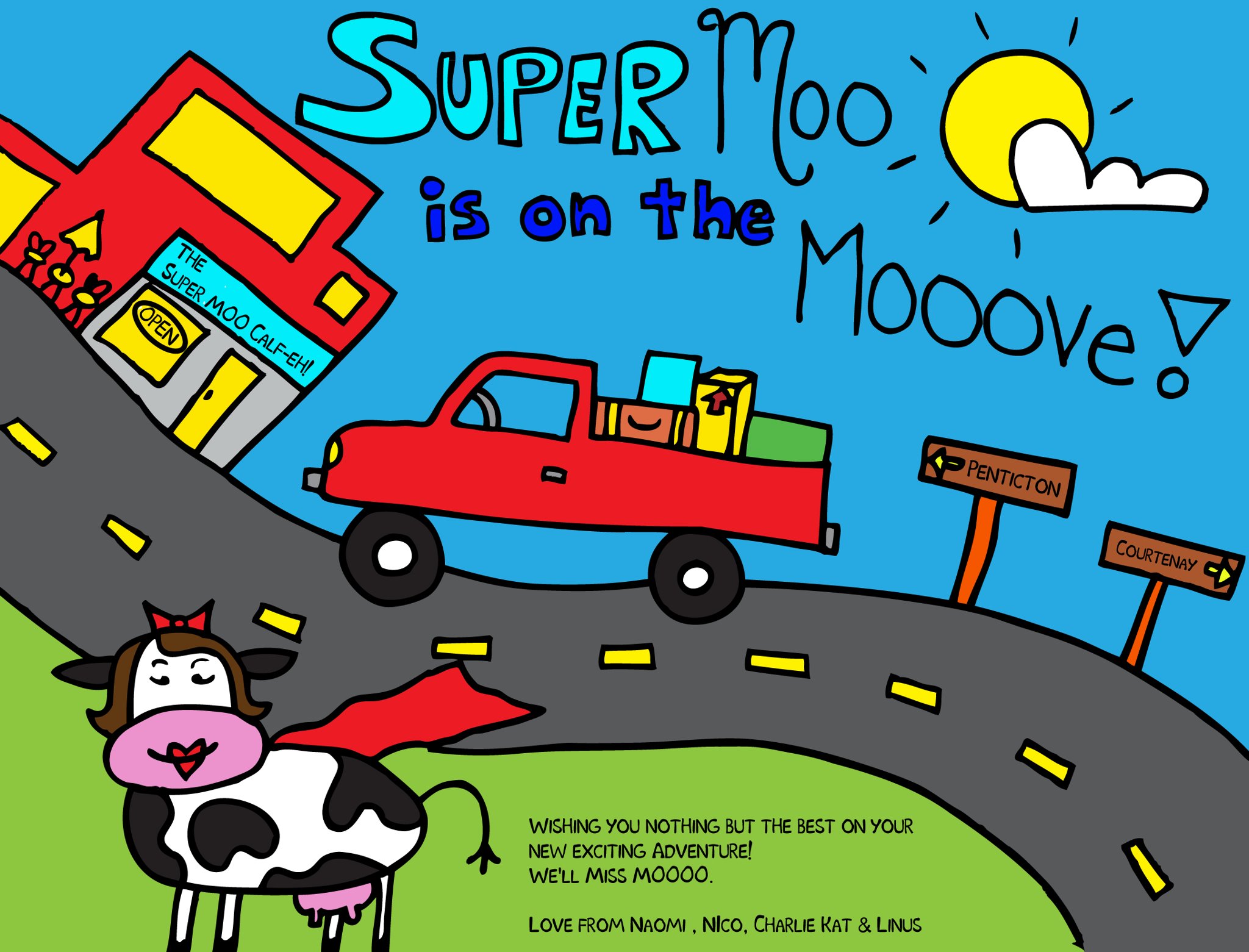
I leave in few days for a brand new life, and a brand new business. I will keep you all updated about my adventure, but today I want to share some art that my friend Naomi Tewinkel created for me. A small word of explanation: my nickname is moo, which is actually short for lovesick moo, it’s a long story. (Did I just tell that to the world, my imaginary friend?)

You can find more of Naomi’s whimsical art here

I think you will love it as much as I do, for her beautiful heart and soul shine in everything she does. Now off I go, not looking back, but remembering every single one of you that I shall not see so often.

On Poetry?

Poetry remembers that language is shaped air; it remembers ashes to ashes, dust to dust, wind to wind; it knows we don’t own what we know.It knows the world is, after all, unnameable, so it listens hard before it speaks, and wraps that listening into the linguistic act. ~ Don McKay


I came across this lovely evocation in Robert Bringhurst’s book “Everywhere Being is Dancing”. I find something completely profound in this little snippet…Bringhurst goes on to write about it for several hundred more pages, bringing in other themes and uniting the whole in quite a staggering way. Meanwhile, I remain immersed in the idea of wrapping listening into language…

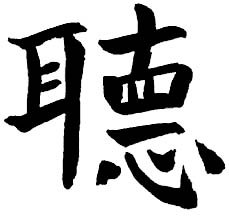
And here is the Chinese character for listening: on the left, the sign for ears, while on the right, from top to bottom, the signs for eyes, full attention, and heart. What a beautiful visual metaphor for the engagement of listening.

And that is what I have been doing, my imaginary friend, listening to the sounds of the world and pondering the ineffable beauties of poetry.

Wednesday, February 29, 2012

I cannot shake the idea that this day has some magic, somehow. Of course it is a calendar correction, and Wikipedia has a fine article on that. Doubtless you will have been inundated with stories of the folklore of the day as well. Still, a day that exists only once every four years… Not quite exactly, but do read Wikipedia for details.

 So here we are, and what is this magic, anyway? I want to dig down, deep down into this feeling; something like being on a cusp. Or perhaps merely the anticipation of Spring? Sigh. By now you will be asking yourself, my imaginary friend, just why you are reading this stream of consciousness.

 It has to do, I think, with the idea of reviving a feeling of wonder in the ordinary and the prosaic. The way we used to come together, in the community sense, merely to mark in some shared way all manner of things. The first of May. The harvest. The turning of the tides… These ideas changed over the course of centuries, naturally, though they seem almost ghostly remnants, now.

Well, here is my insignificant contribution to marking this day, this year. Because the magic I believe in is that spark that yearns for connection. Beyond the connection of family and friends, the connection that extends to town, or city, or village, to nation, to culture. That we share some simple experiences, and because we share them, we shall make note.

My Garden

Signs of Spring everywhere: buds fat on the forsythia, peonies pushing up, crocuses beginning to bloom, and although a glorious day of spring-like weather has yielded to a miserable, chill, and windy day with wet snow flurries predicted – yet, my mood turns to Spring, maybe. A ghostly fragment of a poem keeps coming to mind:

Something’s up, young Hank

Something green

Is beginning to push its way

through the crap and crud of reality…


My apologies to the author, who is, I think, Adela Rogers St John. This, a fragment typed onto a note on a fridge door a long time ago, echoes in my memory but perhaps imperfectly. There is a story there, for certain, but not today, and I write not of the weather today except metaphorically.

 I have been deep in thought these past weeks, deep in reading learned treatises, deep in attempting to answer my burning question. The lack of being able to articulate that burning question precisely has no doubt hampered my quest for the answers, but I believe the essence of it is this: Why are humans so wary of those who are different? I am aware of those who posit this as an evolutionary advantage, a necessity of tribal life: this person is the tribe, that person is not and distinguishing the difference between the two might well have marked the difference between life and death. So perhaps this question is not really more central to our times than those more savage past times. Do we have more freedom, or less, in the sense of our social structures as compared to, say, a feudal society? Not a question that can answered definitively. Many historians assert, for example, that a feudal peasant would have worked less hours than the average Canadian or American of today – this is in contrast to the popularly held view, of course.

 In any event, I can only ask the question from my perspective of my time on earth, and it seems to me that the parameters of social behaviour have become much narrower, more tight-fitting, and for me, they begin to chafe. Not just for me though: in my local paper last week a woman wrote in to say how much she had enjoyed a night out dancing, which was however marred by the sheer number of strangers who had to come and tell her that it was great to see her dancing “at her age.” I do not know the woman, or what her age is, but I can feel for her. Sometimes I would like to jump and skip and express my delight and exuberance but I find it provokes reaction. Speaking directly provokes reaction. Having a third drink provokes reaction. Asking for seconds provokes reaction. Anyway, my imaginary friend, it’s not so much that I don’t understand these little rules of social decorum as that I don’t care to be characterized or guided by them. How sad that joy and exuberance and pleasure in being alive should place one beyond the pale, so to speak. Or at any rate, out of the ordinary.

 This cookie-cutter life, this idea that we ought be pleased by the same things, enjoy the same entertainment (but not too exuberantly), share the same goals in life (marriage, children, and accumulation),  and talk only of the ordinary and the superficial; why, perhaps it was unleashed upon us by mass marketing and advertising, but it remains with us because we simply cannot face our fears. That may or may not be true for us as individuals, but it is most certainly true of our socially-constructed worlds. I see no choice but to resist the fear. Dance a jig. Say shit very loudly when warranted, and when you mean shit, not manure. Live your joy when you feel it. Maybe the crap and crud of reality shall become the garden’s compost.

Coming of Age

Ah yes, they were strong elder women. They had to be, you know, life was hard, then. Quick-tempered they were, and tongues that could wound very deeply. Then there was another generation of mostly girls (the story of the boys is their own to tell), and they too were ‘strong’. And that generation of beautiful women raised yet another generation of ‘strong’ girls.

Being ‘strong’ had different connotations in different generations, but always it meant being the perfect princess. Smile! Work hard. When your family comes to visit, show them you are in control by being the perfect hostess with the perfect home and perfect children, naturally. Feelings are irrelevant, not important, and must be ground down at any cost. It is the appearance of things that counts, and smile, smile for the camera. For if the camera records a happy, smiling family, then it is a happy, smiling family, right?

 Sadness, fear, or anxiety are not manifestations of the perfect princess, and therefore will not be expressed, upon pain of punishment. Sometimes physical punishment, but more often shaming: look at her, she is being sad and clearly there is no reason to be sad and so we will push her to the outside of the family circle for awhile, that will teach her. Every family gathering for unbroken spans of decades begins with an argument, and hurtful rejoinders are flung about, but that is no reason to be sad. If it seems paradoxical that anger is expressed, why, just think of all those natural human feelings being hidden. Anger is strong!

Playing favourites among your children – letting the others know that no matter what they do, they can never be the favourite – that is another way to ensure control of the family. The dysfunctional family archetypes of the scapegoat, the lost child, the hero, and the mascot reveal themselves in personalities at a young age, for they are the means of coping with the bad feelings of the family dynamic. Everywhere and in everyone there is evidence of the feelings being suppressed and sublimated in a myriad of ways such as alcohol and substance abuse, overeating, overworking. Often, all of these. It is never anyone’s fault, what happens to them, always the fault of someone else. To own otherwise would have to be to own the pain and vulnerability of being fully human, of being imperfect, of making one’s way in an imperfect world. It  is just too hard. No matter: for this is a strong family, a happy family, and the pictures say so.

For the small, sad little girl there – in the corner almost – there is no regard, she is not playing the game. It is to that small, sad little girl – and there were many of them – that I write. As gently as I can, I want to tell you that you are not imagining things, that everything is not okay, and that it is healthy to express sadness over what is bad. That vulnerability, expressing your innermost feelings is painful, but that vulnerability is “the birthplace of joy, creativity, belonging, and love…”

I know this is hard, but please watch Brene Brown in her Ted Talk. Understand that your emotional honesty will cost you, but that it is preferable to living a life dampened of joy and spontaneity. Emotional honesty may feel like betrayal to members of your family who have not gotten there yet; maybe they never will. Emotional honesty is not cruel or spiteful, not derogatory or shaming or belittling – it is honesty about your own feelings, not the presumption of speaking for another, and above all, it is not blaming. I just want to say it again because it is so important, and so liberating:


Vulnerability is the birthplace of joy, creativity, belonging, and love.


 To that small, sad little girl: I love you. You will be okay, even though it will be terribly difficult. Contrary to everything you have been taught, it is the most vulnerable amongst us who are the strongest. Wholeheartedly, I wish you joy.

Santa Claus, North Pole, H0H 0H0

Dear Santa,

Here it is Christmas Eve, and I know you are busy on your rounds. Last I heard you were just leaving the Sandwich Islands, but that was an hour or so back. Anyway, it is the traditional time for writing letters to Santa, although the old story says that the letter is supposed to be tossed into the fireplace, and as it burns, the pieces will fly up and magically reassemble themselves as they wend their way to the North Pole…

Alas, no fireplace here. But still, you do have a Canadian postal code, and I am pretty sure you will read my letter. There is no point telling you I have been a good girl, I suppose. I have been impatient, as usual, with stupidity and willful ignorance, and I am not very cheerful in the mornings. I have tried to be kind, and thoughtful of others, and sometimes I have succeeded.  I think I have done my best, but goodness knows that is not enough.

In years past I used to ask for such gifts as world peace, and an end to starvation, and all manner of things of social justice. I have come to realize, though, that your magic is of a different sort: the kind of magic that works one child, or one adult who believes with the purity of a child, at a time. But it is powerful magic, for all that it is not what I once believed it to be.

If we could each bring the magic of happiness to one person this Christmas, what a transformation there would be in the world! The happiness that comes from being special in someone’s eyes, of being treasured, of being seen for who one is.The magic of simple human fellowship, of the fabled good cheer, of the visions of sugar plums that actually come to be in one’s hand. The magic of the old and familiar stories, and maybe room for some person who is new to our world. The magic that sees the glow of love on someone’s face, and remembers the echoes of love from those departed this earth. The magic that looks and sees not a silly and funny old present, but the look of anticipation on the giver’s face, and the radiance of the joy that elevates the gift to so much more than its prosaic origins.

I believe with all my heart, Santa, and so I guess what I am asking for is a more liberal sprinkling of your magic dust this year. The earth and her children – and we are all her children – need you so very much. I know the supply is not unlimited, but a large sprinkle this year might just help us over the hump. Anyway, so I humbly ask.

There are cookies for you here. I love you. Merry Christmas.

VivianLea

Winter Solstice

I love this day, perhaps in part for the romance of unbroken centuries of denizens of the northern hemisphere celebrating the return of the light. True, it is not as exhilarating as watching the sun rise over jagged mountain peaks on midsummer day, yet the summer solstice is tinged with the faint regret of being at the apex from which the days will slowly but surely become shorter. But now, in mere moments, the days here will begin to lengthen, and the promise of everything to come is very sweet.

 I have observed and marked the solstices as long as I can remember in some fashion or another, and I confess to surprise at people who pass them by, unremarked. For thousands of years they have been important celebrations in a myriad of cultures, and I suspect that something is lost to modern life when they are unnoticed. One need not be a follower of paganism, or druidism, or some colourful new age ritualism to appreciate the beauty and symmetry of the solstice.

 It would be cliché to say that many modern peoples have lost touch with nature: indeed we are earnestly advised of the ‘nature deficit’ we suffer from. For myself, the hills and valleys, forests and rivers, oceans and expanses of sky form such an integral part of me, of who I am and how my very self has come to be…I observed my fellow citizens out and about today, a gorgeously sunny day, a peach of a day in the rain forest climate that I live in, and they were enjoying the parks and walkways and trails. So maybe, I would say, at least here in this place, we do not suffer from deficit of nature, but from a deficit of wonder…Maybe.

 The wonder of axial tilt, that the earth’s magical, invisible axis tilts at an angle to the perpendicular that gives us the seasons of the northern and southern hemispheres, this mysterious, cyclical round of birth, growth, flowering, decaying, and dying…this seems to me to be a source of endless wonder.

 That me! I! should be a part of this great cosmic order – perhaps you call it God? I do not think it matters, although in writing that I run the risk of offending some, I suppose. But if I have offended you, I hope you will take a deep breath, and join me in a hymn of praise to axial tilt. To the beauty and sheer magic of being alive on this earth, both its measured order and its chaotic uncertainties, for in this hymn of praise shall we discover what it means to be fully human.

 To be fully present to the wonder is to live as humans were meant to live, I think. And by our presence, to turn the wheel one more time to the promise of all that lies ahead. Axial tilt is a wondrous thing.

Are You Ready for Christmas?

I am thinking deeply and intently on Christmas at the moment, memories of a conversation being stirred up by a chance remark while out shopping: “Are you ready for Christmas?” It was somewhere about December 1st, I believe, when a well-meaning, kindly sort of middle-aged woman asked me that question. The memories I refer to here are of a delicious conversational rant I enjoyed with a friend – oh, probably a few years back. She was irritated at the assumptions implicit in the question, not to mention the ubiquitous banality of it, as was I. As if Christmas consists of X, Y, and Z purchases which will ensure the requisite readiness.

 Neither my friend or I celebrate Christmas as Christians, for that is not our religion, which is true for many millions of people. On the other hand, most of the world celebrates some sort of festival at this time of year, and those traditions of the Northern Hemisphere are well-ingrained for many of us. So while it is perhaps a touch insensitive to blithely assume all your fellow shoppers do celebrate Christmas, I am not about to embark on a deconstruction of the politically correct holiday address. Call it Christmas, call it what you will, we set aside a day at the beginning of the winter season to celebrate, and that is a beautiful thing.

What I was shopping for on that day was lined paper, and you, my imaginary friend, will be pleased to know that I am sitting in my favourite 1940s library chair writing on said paper, whilst sipping a cup of Kick Ass coffee. Cogitating on Christmas. That shall be my last purchase other than food necessities until January, for I cannot bear to be a part of the dysfunctional ritual shopping farce that Christmas has apparently become for some. I am curious (and ever hopeful) to see if more people shall disconnect themselves this year. It simply cannot be bought, the magic and charm of the season.

 I was, I think, five years old when my cousin told me that there was no such being as Santa, but I never really believed her, for I could see the spirit of Santa Claus in everyone and everything. The bright lights and beautiful decorations, the special foods and feasting, the treats, the happy, smiling people everywhere and many visitors, the ordinary cares of the world set aside for a few days. Silver-shining blessed moments such as these could only be invoked by magic, I reasoned then and still do.

 Most of my Christmases have been spent with the family I grew up with, though not all for we live far apart. But those moments preserved as memories of the very best of times mysteriously bind us together in ways that cannot be reckoned logically. A couple of gifts stand out: a big box of second-hand books, one year (we are all book lovers), and another – a pony. The entire neighbourhood came out on their doorsteps on Christmas Day to clap and cheer as I rode my pony through the gently falling snow. What a picture postcard scene to hold fast to my heart: my family, my friends, my community showing their joy at my joy.

There is much more I want to tell you, my imaginary friend – yes, it will be a book, and it will be ready next year about this time, I think. I am hoping you will forget this, though, as they are likely to be next year’s gifts. And I am not telling you what this year’s gifts are, although I have been working on them for months. When I finish this I shall start on making some special cakes for friends and family…Christmas here will be full of simple feasts and simple pleasures and simple good cheer. No frantic shopping required.

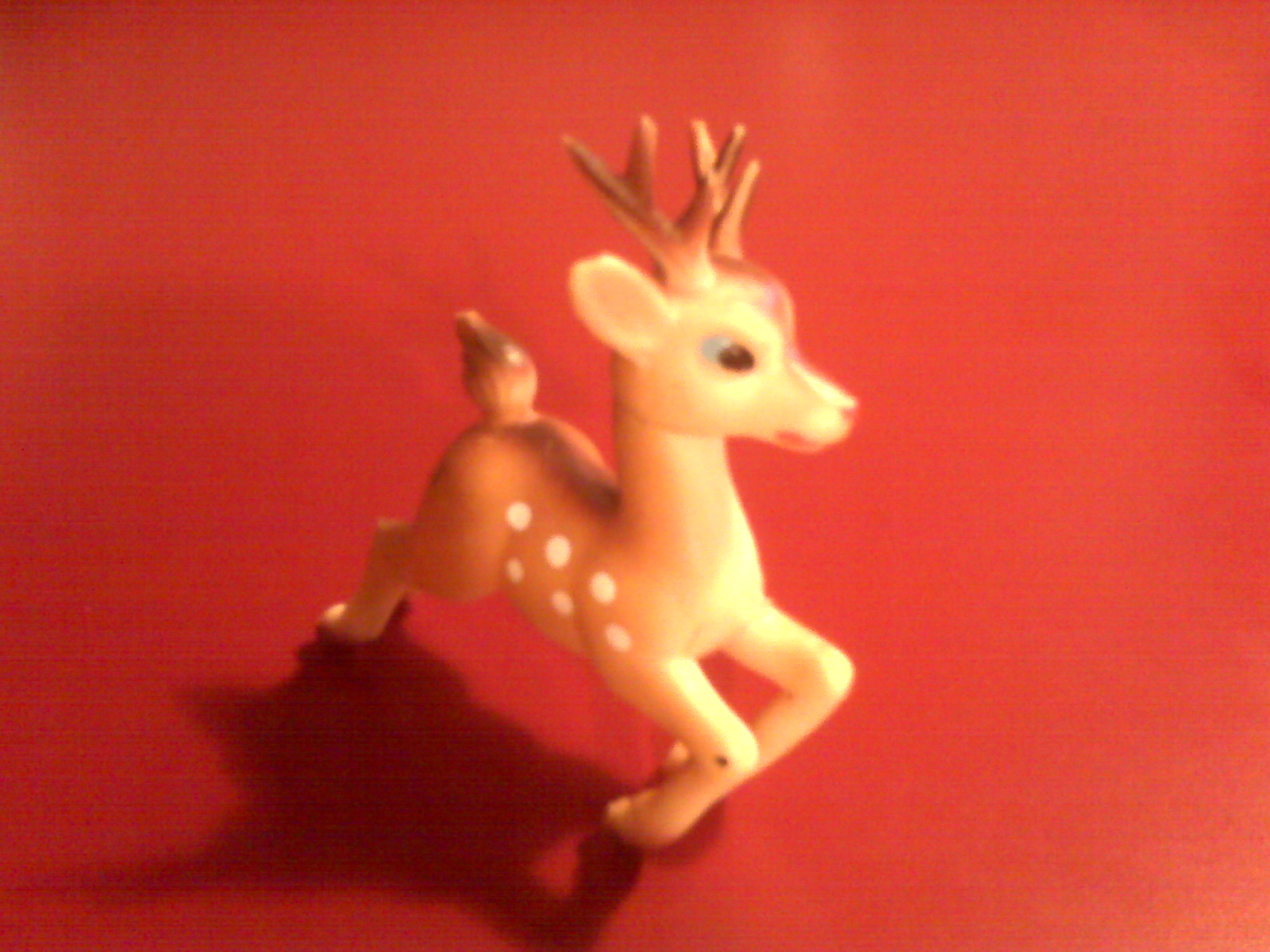
 Maybe I shall end here with a vignette of Rudolph, who is about fifty-six years old – older than me, anyway!


Originally Rudolph pranced about in the snow (oh, that marvelous fake snow that looked so real!) with his team mates and sleigh and Santa, all encased in a golden sort of cage. It was a table ornament, I guess, and I loved it with a fierceness that still surprises me. Sadly, a few years ago the thing pretty much disintegrated, and my mommy gave me Rudolph as a keepsake. You know, when I look at him I remember just how he used to look, proudly leading his sleigh. Never shall that vision tarnish, for it is my symbol of everything Christmas.

 Joy. Goodwill. Peace on Earth.

 Yes, I am ready for Christmas.

Buy Nothing Day

Today is Buy Nothing Day, as brought to you by Adbusters for the last twenty-five years, apparently. I haven’t been aware of the campaign for that long and I am not writing here about Adbusters in particular, but about what this meme has meant to me. For I do remember that the first Buy Nothing Day I can recall found me shopping. I can’t remember the details, but I am pretty sure I went grocery shopping which I have a tendency to put off until desperate – out of food, or out of coffee, more likely.

I suppose I was already absorbing the lesson of how dependant we North Americans are, all but a very few of us in any event – whether we live in big cities, small towns, or sleepy rural villages – most of us  depend on the work of thousands of people to sustain us: to feed and clothe us, to keep us warm, to transport us around. Should any of these systems fail we are in trouble, and that is rather contrary to the picture we like to paint of ourselves as free citizens exercising a choice. We consume because we have to, so the idea of Buy Nothing Day is an exercise – for a day – of examining what and when and how and why we consume, and I think there are some terribly interesting things to be learned from that.

 Perhaps Buy Nothing Day has been misunderstood as a kind of earnest, lefty rant about consumerism, or maybe even conjures up the crusty old Scrooge or some such image. So I want to be very clear that I am writing about my experiences and what I have learned. I haven’t much interest in writing prescriptions for anyone else, save this: that in the quest for the ‘good life’ it is worth examining everything, I think. (I must insert here that I am irritated to have run out of lined paper to write my first draft on, and have resorted to the keyboard. I really do observe Buy Nothing Day, these days!)

 I will take you back to when this began in earnest for me: I was running a business, a rather successful business with thirty full-time employees and usually another dozen or so part-time, and I simply couldn’t keep up with the demand from consumers. I did not see how I could logically manage more employees, more customers, more, more, more – that is, not if I wished to run a small business that brought me a comfortable living. My business consultant thought I should sell franchises, but that didn’t appeal: I did not have it in mind to be an executive, but a small business owner doing the things I loved. I set about creating a business that sustained a steady range of income, that neither grew too much, nor contracted too much, and that proved much more interesting to manage and required me to be much more creative in my planning too.

 It was inevitable that I would look at my personal life too: I think in those days I spent a fair bit on clothes, and shoes, and cosmetics, and books and CDs and going out for brunch, lunch, dinner for lack of time, often, and I also had a small house. I loved the small house and wasn’t willing to move, so managing stuff took up time, time I resented. It was easier to stop buying some of the stuff in the first place, so I did. Everything I decided to stop buying at first was the obvious stuff; obvious because I didn’t miss it and nothing was missing in my life: just the opposite, I had more time and I wasn’t managing stuff. Naturally I had more money: money that went into a savings account, and money that I could be generous with when it came to charitable donations. That giving gave me a lot of pleasure, I found.

Of course, I am trying to compress here a kind of ongoing game I played for more than 15 years. Did I need it? Did I love it?  These were always the criteria, and it is now an absolute reflex, and ingrained habit for me to ask of myself when buying pretty much anything. These days it is out of necessity that my purchasing is restricted – as is true for so very many of us – but necessity does not feel harder than choosing, paradoxically. True, there are things I must give up in order to drink the fair trade, organic, bird-friendly coffee that I love – Kick Ass Roast from Kicking Horse Coffee – but I love the coffee. It is a morning ritual to prepare it just so, and to spend an hour or so enjoying the flavour and aroma and terroir of the bean. More importantly, it is an integral part of my day that brings me immense pleasure and satisfaction. In the main, that has become the ethos of Buy Nothing Day for me: that I do less, and have less, but what I have and do is so much more intensely pleasurable and joy-constructed.

 We are not what we buy, but what we love. No matter what the marketers tell us, we cannot be defined by our possessions. We cannot be defined by which of the colas we drink, and you know who they are, I refuse to name them, and I do not drink them – or what laptop we purchase or what cell phone we  have. Neither by movies we might care to watch, or books we read, or what brand we purchase. For me, there are ‘right’ choices and ‘not right’ choices, and those choices might be different for you. But if all each of us does is to make the choice that feels good and right to us, that brings us pleasure or brings another pleasure, then we have set out upon our true path to a life of meaning. I think Buy Nothing Day is worth thinking about, and talking about, and reflecting upon for these reasons. We can awake to a sense of both purpose and pleasure in the day ahead of us, as well as constructing our days to bring us joy. I suspect that might mean less is more, for some things, and more, much more, of other things. But I am pretty sure we cannot get there without some deep reflection on the ways we spent our money and the things we do to get that money, and of course, all the things that money cannot buy.