Will You Be My Imaginary Friend?

My rather cool blogger friend Teenage Introvert nominated me for an award, which is fun, and I thank him. This award has rules; however, let me say at the outset that I am changing the rules of this game –  because I can  🙂

Up first, 11 random facts about me.
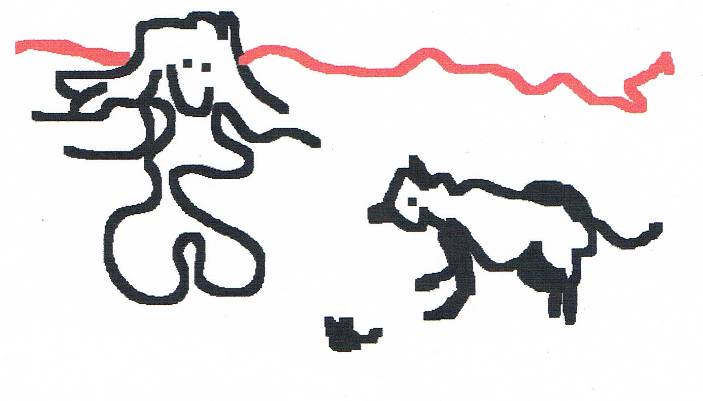
Me, my imaginary cat friend, and her imaginary friend

Me, my imaginary cat friend, and her imaginary friend

My nickname is moo, short for lovesick moo…the story is long. If I were a crayon, I would be scarlet. I believe in love, in magic, and in Santa Claus. I love a cowboy. I like vanilla – oh, real Tahitian vanilla beans, oh yes, oh yes – better than chocolate. I have an imaginary friend. I love the zest, and spice, and adventures of life, although – I am a homebody kind of person; the best adventures happen, I think, when you see your own familiar world in a new way. I adore people who jump into things with arms and hearts wide open. To dance, to play, to sing, to make a friend – to do anything, really, with enthusiasm and curiosity for what is to come expresses a joi de vivre that often seems lacking in our world. I am rather quiet, and enjoy my solitude very much. This makes it both thrilling and frightening to love a cowboy…the fine tension between love and fear tells me my heart is growing a size or two.

And next, the questions that were posed to me by Teenage Introvert.

 Name your earliest memory.

My dad, reading aloud to me from “The Cat In The Hat”.

Let’s spice things up. What is your favourite meal from a restaurant?

I love authentic Thai food, but especially any red curry dish.

 Which sense do you like the most? Why?

All of our senses work together, of course, to create the savoury, simmering stew pot of our lives…but the one I could not do without would be touch. To be held, by someone who loves me. All others fade in comparison.

What was your ideal vision for your blog?

My vision for my blog, was, and is, to have a community of friends who engage with me in its creation.

 How well do you deal with your emotions?

I try to express myself, always, in ways that are true to what I am feeling – my deepest inner feelings. It is easy to be flip, or funny, or sarcastic, especially when it is uncomfortable to be vulnerable…This is courage, I believe, of the highest kind – to express yourself honestly and openly, with care for the feelings of others, and with grace. It is a courage I am still learning.

 Would you rather…kill your best friend, or have your best friend kill you?

If a friend were to assist me to die at my request, that would be a blessed thing. If I were to help a friend to die as they wished, I believe that might be the ultimate gift of grace and love.

 What was your most vivid dream/nightmare?

My dreams, and my occasional nightmares, are always vivid and impressionistic. They feel rather like finger painting.

 Do you like where you live?

I love where I live, which is an extraordinarily beautiful place where many of my friends also live. Never the less, I am ready to move on, because other loves call to me.

 What was your first experience on a social network/forum like?

My experiences on social networks of all kinds have been simply amazing. I enjoy the easy give and take of ‘virtual’ friends, and have been privileged to meet many of them in person. There is something about the intimacy of the written/visual that illuminates people’s hearts quite well, I think.

 What’s your main past-time hobby?

Reading and writing are the activities I spend the most time on, because this is what I love to do…but these always have to be balanced with hiking, canoeing, riding, biking…always, time to play outside.

 How do you feel about this nomination?

I think the nomination is great fun, although strictly speaking it doesn’t apply. I’m enjoying participating in the spirit of the thing!

 Now, according to the rules (!), I am going to pose 11 questions, although I shall not nominate anybody. This is a time-consuming exercise, and many of us are pressed for time…So let me say this: you might simply ask yourself these questions, and answer them in your own mind. You might blog this game, and do let me know if so! You might, if you are really courageous, choose to answer the questions in comments…which I would love! Participate in a way that feels comfortable to you.

11 Questions to my imaginary friends:

 Who, and what do you love?

Why?

Do you have an imaginary friend?

Kisses, or hugs?

What does integrity mean to you?

What makes you fearful?

Can you taste colours?

Besides love, what makes your heart sing and makes you jump for joy?

Vanilla, or chocolate?

What makes you curious?

Will you be my imaginary friend?

 Ah, thanks for reading, lovely people. Love and friendship ask us to share in ways that are not always comfortable…If we are honest, we must acknowledge that our singing hearts and joyful jumping are sometimes restrained because of that very discomfort. Yet, love and joy are the perfume of life…I am so pleased, my imaginary friend, that I can tell you anything, anything at all.

The essence, I think, the essence and essential spirit of participating in this exercise is to share something of ourselves, to share and thus to invite the sharing of others…for it must go both ways. Sharing is a word that has been much overused, but one need not be profoundly philosophical, reveal one’s innermost secrets,  disclose one’s greatest embarrassment, to share oneself. The simple and the ordinary, the daily ritual, the spark that lights up the face…these are all pieces of ourselves that will let others be our friends. We cannot have friends unless we can be friends …and we must make more friends, for our world so desperately requires it. Our world needs us to know each other a little better, to banish the judgements of first impressions, to share our joys and sorrows, to move beyond the superficial and strangled and straightened … streaming from the lake of desire,  into the river of playful imagining, and washing down to the sea of joyful possibilities…

I hope you will be my imaginary friend, and just so, the possibilities are limitless.
Sweetness

Honeyed. Fresh. Golden. Perfumed with spice. Clear. Keen. Engaging.

This is how I describe my life today, at this moment, on the cusp of another birthday that brings me to the magic number of 57. All numbers have some magic, of course, but this number – oh, this number – sees me overflowing with the sweetness of life, with the sure and certain intuition that focus, intent, and direction of course are aligned. That life follows its true path, like an arrow skillfully loosed…

I hear you, my imaginary friend, bid me bask in the golden moment, while keeping a sharp eye out for the curves and thickets ahead. For we know the road is never straight, and the end is only visible towards the end. Never the less, the delighted anticipation of what is around the curve is a large piece of my joy in life at this moment. There will be a thicket or two, I am sure, but these must be seen to be navigated, and I am not there yet.

Of what is this lyric happiness composed? A glorious summer, with the promise of a spectacular autumn ahead. The practise of craft and the honing of skills. The love of family and friends. You, of course, my imaginary friend, you. And perhaps some would call it the mellowness of aging, but which I think is more the understanding of my own true nature, the willingness to let the real me emerge and be seen.

My twenties – thirties – forties – much came easy to me, though the folk saying of be careful what you wish for comes to mind. I wished, and therefore I got, in those days, only to wonder why it did not satisfy. The genie in the lamp is much more reticent, now; he grants me only what will live in my heart happily. Or, perhaps he grants me the discernment to know what ought to live in my heart…

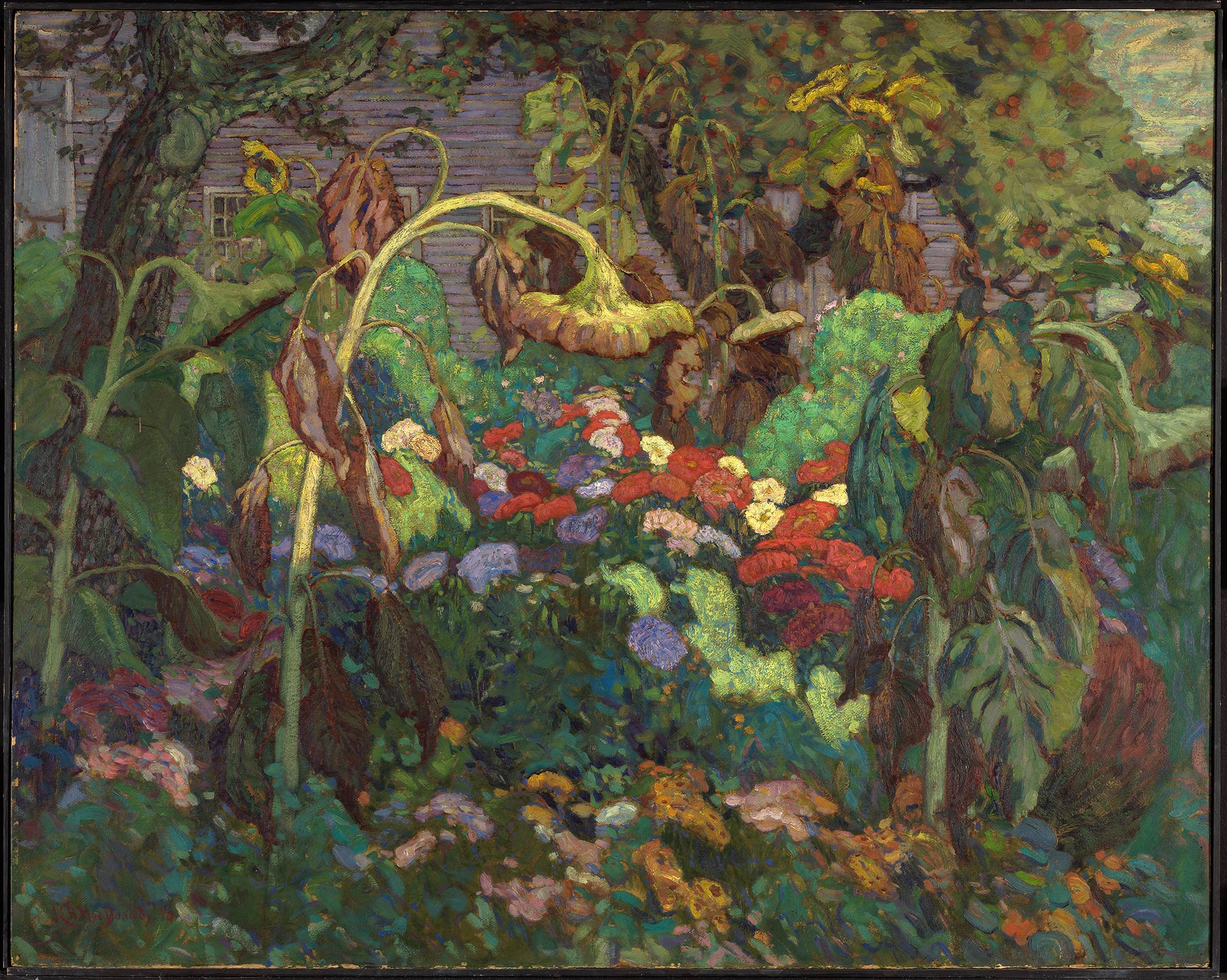
And you, my imaginary friend, you. You live in my heart…my honeyed, fresh, golden, perfumed with spice, clear, keen, engaging heart. It is a tangled garden, but beautiful for all that, I hope. It does not grow in orderly rows or tidy plantings, but sprawls and runs riot and reaches for the sun and glows with the warmth of the good earth…

The Tangled Garden, JEH MacDonald, National Gallery of Canada

Just so, like that. What shall you make of it?

Small Talk

Edge-Icons


I’ve been writing this piece forever, it seems, or maybe more correctly, discussing it with my imaginary friend. Since I have made a point of proclaiming my dislike of small talk and chit chat, it seems natural to want to expand upon this. In any event, the effort to do so has taken me on quite a journey.

An internet search of ‘small talk” will yield mostly predictable results: a lot of why it is essential to your business, how students of English as a second language can benefit from understanding small talk, and of course, rants against small talk. (The Urban dictionary has some exquisitely funny expositions, linked here.) Few of these really get us close to the truth of small talk, however. The language of business is mostly banal and lifeless, a kind of deadened language. Those earnest students of ESL can be forgiven for wondering why we endlessly talk about the weather, but not climate change. Small talk is also linked with gossip – horrors! Also with politicians, the television news, and the public statements of CEOs, all of which are carefully scripted to be innocuous, rehearsed to be delivered smoothly and blandly, and have no substance because they invite no conversation.

“Hello” or “How are you?” or “Hi” are all ritualistic: acknowledgement of person. Body language is about eighty percent of conversation; it is generally the body language of those we acknowledge or respond to that determines whether or not conversation will ensue…Small talk can sometimes be a  bridge to conversation, and sometimes simply more ritualistic exchange. Body language can be a more direct way of getting to conversation: think of saying “hello” and smiling broadly at the same time: this is a very clear indication. Note though, that it is not perceived as an invitation if the smile seems insincere – body language is largely below consciousness, but humans do astoundingly well at distinguishing between real, unfeigned interest and mechanical greetings. Put another way, when we look at people with interest and anticipation of a conversation, conversation often happens.

We aren’t yet finished with small talk, though. Think of flirting – yes, flirting, we pretty much all do it. If we were to analyze the content of that enjoyable little flirtation – at the coffee shop, say – it would seem that the words, the actual content, were nothing but…small talk… Though it was so delightful! And left us feeling, well, a little happier for an encounter with a pleasant someone or other. Romantic flirtation is probably even less conducive to word analysis, for of course, voice and intonation, a myriad of physical gestures, long looks, and even dilated pupils all play a role in people flirting romantically But were we to replay the words outside of that context, we would likely be bemused at what actually occurred. How did so much of substance and import get communicated? We must also consider small talk in the context of the internet and technology: chat, texting, Facebook, Twitter, blogs, and on and on – much of what we communicate through the technology becomes shorter and shorter bits of text. And yet, we manage to infuse it with meaning, convey flirtation and love, bridge time and distance, and transcend social, geographical, political limits and all manner of things that might be perceived as barriers in non-cyberspace.I believe my musings on small talk have brought me to this: it is a necessary piece of human social interaction, in ways that I have perhaps not considered before. There is much that goes unsaid in most conversations, except perhaps the most intimate and prolonged, and what one says is always interpreted in light of the mind and experiences and circumstances of the hearer. Certainly, one need only think of tweets that have resonated around the world to recognize that even one hundred and forty characters can change the world…

I will paraphrase the words here of Theodore Zeldin, Oxford University historian, and his ideas on fostering conversation. That people are interesting and ought to be sought out. To think, while you are speaking. To use conversation to create courage in the face of failure. To resist the cynicism that is the hallmark of  our culture. To change the purpose of conversation from personal advancement or denoting ones’ respectability to remaking our world. These words and ideas of Zeldin’s are very stirring, but it seems to me that if we think of them as only to be practised during ‘high’ conversation, that we are maybe missing the point. It seems to me that they apply in even the most banal of times and circumstance, and that maybe, this is where the potential to ‘remake our world’ is greatest.

There is much more to be thought about than I have written here, of course, but never the less I hope you will not find it small talk. Feel free to tweet your thoughts, or to leave a comment, but most of all, I hope that maybe you will discover that some small interaction of yours has indeed, helped remake our world.

What Stories Will You Live? What Stories Will You Tell?

Today’s blog post is brought to you by the book “Monoculture: How One Story Is Changing Everything”, by F.S. Michaels. Michaels begins with the proposition that a “master story” is a governing pattern for a culture, and uses the examples of the religious monoculture in 16th Century Europe, which then gave way to the scientific monoculture. In our time, she says, the monoculture is economic, and provides chapters on how work, relationships, community, health, education, and creativity are shaped by economic values and assumptions in the 21st century. This is a well-written book, easily readable at 134 pages, and with 55 pages of notes, clearly well-researched. I do not know F.S. Michaels, but I enjoyed the book immensely, several times. The moment for readers when they come across a piece of writing that articulates something in themselves, half-formed/inchoate, in marvelous lucid fashion, is akin, maybe, to seeing a friend in a crowd of strangers.

“Call a thing immoral or ugly, soul-destroying or a degradation of men, a peril to the peace of the world or to the well-being of future generations; as long as you have not shown it to be ‘uneconomic’ you have not really questioned its right to exist, grow, and prosper.” It is worth asking you to read the quotation again; it is from the late economist E.F. Schumacher. This is the world that has come to pass: a world in which the vilest child pornography thrives, because it is economic. In which hunger and homelessness abound, because it is economic. (To clarify, it is widely believed that it is uneconomic to rectify homelessness/hunger.) In which climate change begins to pose real questions of how humans will survive, yet no governments can seemingly conceive how to begin to solve the problem, and where will the money come from? And this is worth thinking on: how could a story, an idea, come to be so pervasive that we allow it to threaten all life on earth?

There have always been those of us who don’t believe the story, of course, who don’t see ourselves first and foremost as ‘economic man’. Those who don’t believe, but pretend to, form a percentage as well, and how shall we ever know how many these are? For the one certainty is that the economic story is central to our very survival, though tangential to our real lives. And here is where my story becomes personal, in a way that is not altogether comfortable to tell.

I have never been able to make economic decisions at the cost of some commitment to the truth, or to doing the right thing, to some higher good, or to creativity and imagination. In my first job I was hired at X wages as a hotel housekeeper. My employer praised my work, and within days I was promoted and training all the new hires, a considerable number. I was really enjoying my first foray into the world of work until my first paycheque, when I discovered that the employer was paying me less than agreed upon. My appeal to fairness fell upon deaf ears, so I complained to Labour Standards, and my complaint was upheld, for the offer was in writing. I was out of a job, however. When I began my own business some years later, I researched the prevailing wage rates and decided to pay my employees at the highest (union) rate for the work. My business grew quickly, had the major market share, and enjoyed a profitability ten percent higher than the competition. Imagine my surprise, then, in applying for a minor line of credit, to be required to defend my higher than average wage costs. In fairness to the Credit Union lending committee they granted my line of credit, but I was forced to state the obvious: that paying a living wage and keeping employees, rather than seeing them as disposable labour, was integral to my sense of doing ‘good business’. I’ll offer up one final story: as the newly-hired executive director of a non profit arts organization, I discovered a number of uncomfortable things. Such as the ten thousand dollars as a specific grant for one purpose apparently having been spent – well, elsewhere. No membership list, although membership was paid, no filing system, no information about such basics as how much was in the bank account and insurance. A government body demanding information from me about a Record of Employment for a previous employee that it believed to be questionable. Meanwhile, the board declined to act or to fulfill their obligations under the Societies Act, and my insistence that integrity was crucial to the existence of the organization got me fired, though I would have been forced to resign in any case.

I tell these stories because it is self-evident that there are principles of fairness that matter, maybe even more than ones’ livelihood. Or as F.S. Michaels puts it: “When what we once valued intrinsically – truth, beauty, goodness, justice – becomes just another means to an economic end, and we accept life within the monoculture, we are deprived of our higher-level human needs.” I cannot pretend to have the answer for how anyone else lives their life, but I can comfortably assert that we must begin to look at human needs beyond the economic. That truth and beauty and goodness and justice really do have a transcendent value. That we really cannot eat money. That the world cries out ‘let me live’.


“The choice is yours.

What stories will you live?

What stories will you tell? “


My thanks to F.S. Michaels.

A Beautiful Object

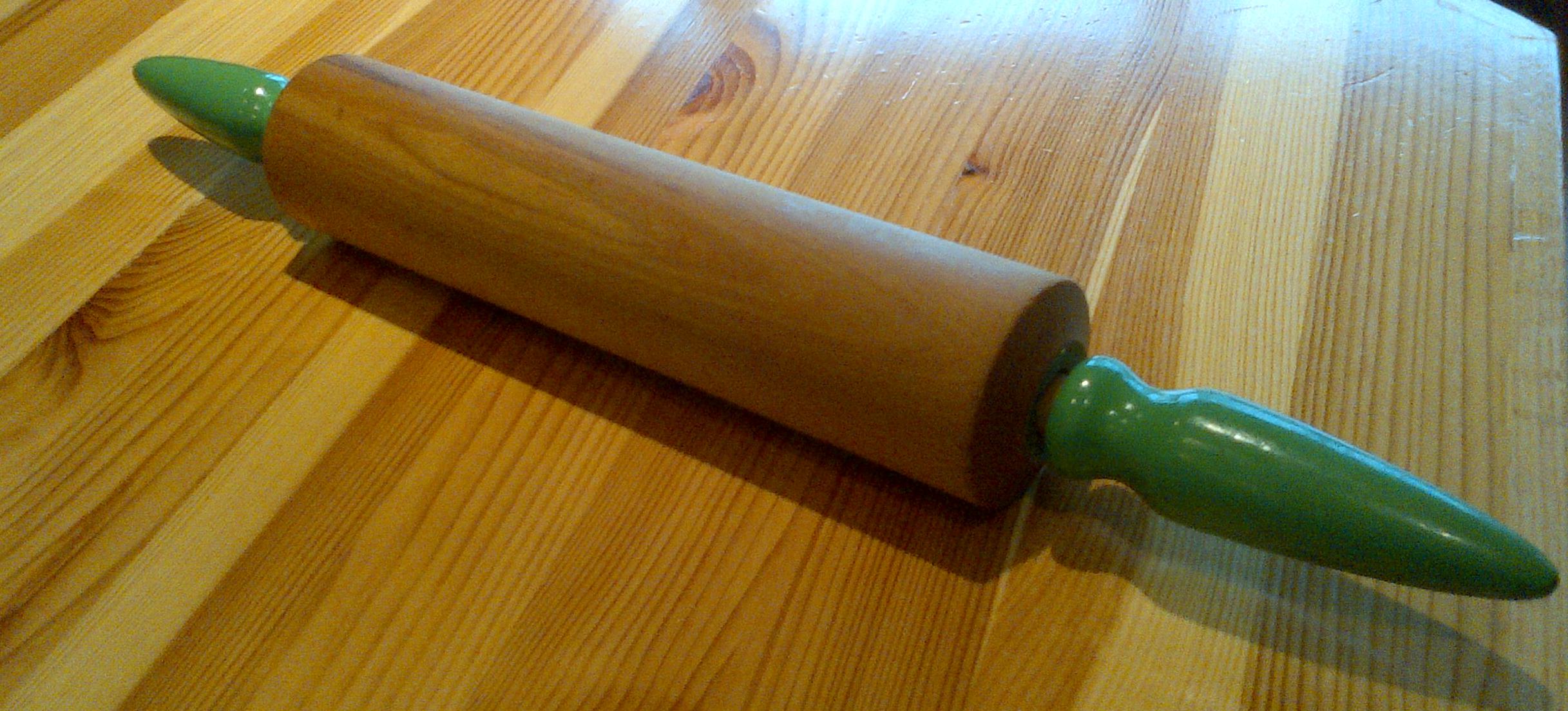
I’ve been wanting to write about this rolling pin for a while now, my imaginary friend. It came from a lovely little shop called Cottage Fever –  it caught my eye because I use these things, but also because it was beautifully cared for. I am guessing the rolling pin is more than fifty years old, without a nick in its painted handles and its surface oiled and unmarked. It  has quickly become one of my favourite tools; and you will be pleased to know that I endeavour to take equally good care of it.

rolling_pin

Of course, I don’t really know the story of the rolling pin. I’ve seen many of them around, in vintage and second-hand shops and flea markets, though never one as well cared for as this, and I think there is a story here. Well, there are probably many stories…I caught myself and still catch myself wondering about the person who owned this thing and who clearly loved it. I understand why s/he loved it – it is beautifully balanced, made entirely of wood, and a joy to use. Why it came to be sold, given away, or discarded is another mystery. Although I use different rolling pins for different doughs,  it really would not be possible to buy something new that is better than this almost-antique – and that is terribly sad. We have become a culture where it is possible to buy anything, where technology is amazing and life-changing, where stuff is everywhere – and yet, the idea of things that last, that might be passed on to another generation seems laughable.

It is true that there is an emerging consciousness of ‘artisan’, which has mostly been confined to the realm of food and drink. But even as mass manufacturers and fast food places have co-opted ‘artisan’ for their branding slogans, the word becomes difficult to use…There is also a movement called maker culture, which seem to be very rich and eclectic and busy making, re-making, recycling, and up-cycling everything from clothes to furniture to art. Maker culture tends to be marginalized and artisan has been co-opted, but unquestionably these ideas and others can show us the path to a beautiful, fuller life.

To go back to the story of the rolling pin, the person who owned it had time. Time to bake things from scratch, but also time to take care of the tools at the end of the day. It is certainly true that fifty years ago, around the time the rolling pin was born, almost everybody cooked from scratch, partly because there was not the plethora of packaged and regurgitated food available that there is today. So there was more time, and better food…This is not meant to be nostalgia for time past, however. The most likely story is that the rolling pin belonged to a woman, that she did not work outside her home, or at best, part time, and that her husband worked at a job that paid sufficiently to buy the family necessities. This is most likely simply because statistics tell us that life was like this for the middle majority at that time, but it is not an argument for a return to this version of time past.

What it is an argument for is a life filled with some small beauties and depth and flavour, of enough time to spend a few hours baking something special. Or enough time to make, or remake from the thrift store, a pleasing piece of clothing. Time to plant a garden, and time to tend it. Time to preserve the fruits of that garden. Maybe most importantly, time to smell the roses in the garden – time that is unscripted, unproductive, and gloriously soul enlarging. This kind of time is rare in our culture; not only does it have little value but it is actively denigrated by those who are ambitious and status-driven and dollar-defined. My rolling pin has little value for them, either. But for others, the rolling pin could be a metaphor for much that is missing in our lives, and a reminder that living with less might actually be living with more.

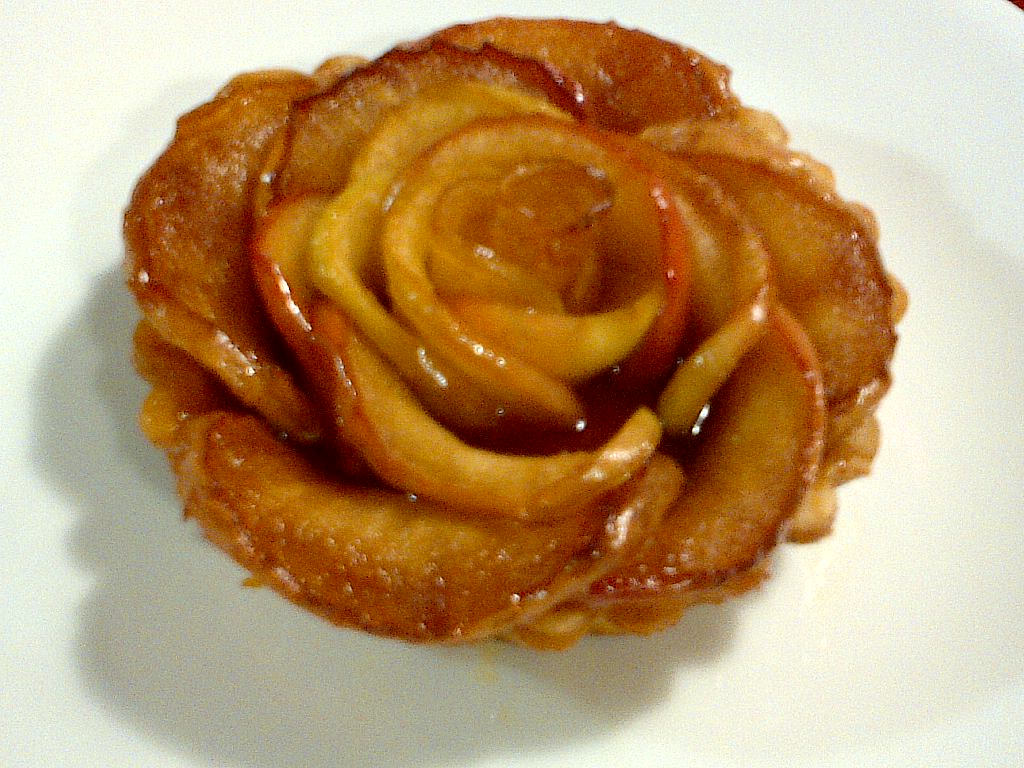
I will leave you with a picture of my most recent creation with the rolling pin. These were not particularly time-consuming – but I have a bit of practice! The impetus was to spend an hour or two being creatively engaged – and, of course, dessert, which is a rarish indulgence here. For me, the rolling pin and the fruits of my labour are a personal response to the threats of climate change, our landfills overflowing with food packaging, generations searching for the meaning of life in meaningless jobs and endless commutes…just so. It seems to me that the way forward, the intelligent response to these very real crises, is for each of us to make the time and place for objects of beauty and creative engagement, in whatever way is true to ourselves. To reclaim a portion of our time from popular culture, from consumer products and passively consumed entertainment. To expect more, while choosing less.

096

Yule Tidings

Dear Santa,

I write on the very afternoon of the winter solstice: the earth now at the point where the northern hemisphere is at its furthest tilt from the sun. And so we celebrate the return of the light, for every day grows slightly longer now, even this day. Thus it has been for many thousands of years for us humans, a time for stories and feasting and the light and warmth of home and hearts made joyous by the love light shining.

I write a little early this year, for I know you are saddened by recent controversies in your name. There was a silly woman who insisted you are white, and an equally silly man who insisted that you don’t exist, and likely a few other gems I have overlooked. I don’t think you are white, for the books all say you are rosy. And of course, we know you exist, for we collectively imagine you into being every year, and millions of children await, and have awaited your generosity, and are better people for understanding generosity. We need you and your magic more than ever. Sigh. I think perhaps I have written those words before. Never mind, there are bound to be some repeats in all these years of letters to Santa.

Anyway, here is what I am asking for: a little more of ‘out of the ordinary’. There was a time before you, Santa, when it is said that Yule celebrations lasted for weeks and even months. Now it is mostly reduced to one day that is set aside from the ordinary. On that day we shine, oh, we shine – we love, and share, and feast, and tell stories, and mostly there are no hard words. But quickly the ordinary falls back into place, for these days the gods of commerce reign, and they are mostly angry white men who are pleased only when everybody is at work. We go back to work because we must – these are demanding gods – and somehow that shining spirit loses its lustre, and we forget how marvelous we can be. And we forget this is a season.

So please, a little more out of the ordinary, for the suffering folk that appease the gods. With, perhaps a merest sprinkling of tolerance, for is not the fact that we do not all celebrate in the same fashion delightful? Love and joy and sharing and feasting may be all we have in common, but are these not the most powerful commonalities? Truth be told, they are much more powerful than the angry gods of commerce, and for every day that we extend the season of joy, we diminish their rule.

I love you, Santa. I have tried to be kind and good, but the approval of the Enbridge pipeline may change that. Anyway, there are cookies for you here.

Blessings of the Solstice. Merry Christmas. God Jul. God Jol. Vrolijk Kerstfeest. Buon Natale. Maligayang Pasko. Joyeux Noël. Nadolig llawen. Boldog Karácsonyt.

TV news? No thanks.

Breaking News! Well, perhaps that is a tad overstated, but please watch the story aired here.

Yes, go ahead, watch it again. Does it strike you that there is nothing newsworthy about it? It certainly struck me that way. Does it strike you that we still don’t know the story of what happened in the restaurant? It certainly struck me that way. Let’s recap the bare outlines of this purported news clip: a small restaurant owner asks a customer not to bring her children back, which apparently humiliates the customer, and then posts a picture to her business Facebook page. You can be forgiven, my imaginary friend, for wondering why this should warrant a ‘news’ story; why what is essentially a  private action should be given the full nighttime news treatment. And I do mean treatment… The reaction to this is thousands, yes thousands, of comments both on the restaurant’s Facebook page, and that of the TV station, most of which appear (I did not count) to be negative, vulgar, and threatening.

It is self-evident that all these commenters were not in the restaurant at the time this story unfolded, given their sheer numbers, so their comments – including threats to boycott the restaurant – are based completely on the ‘news’ story. It takes little effort to see the ‘hooks’ that have been built into the story: a restaurant owner that doesn’t like kids! A military mom whose husband is deployed, sob! How could anyone be so callous as to berate a military mom! The truth appears to have been lost in the edit, or perhaps the questions simply weren’t asked. Just off the top of my head, here are some questions that might have been asked: did the customer make any attempt to clean up after her kids, or to offer an apology? If she was humiliated, why did she cross-post the restaurant’s Facebook post to her own page? Did that have something to do with revenge? Was the owner respectful in her request to the customer in asking her not to bring her kids back? Was it really a confrontation?  Is there something more to this story?

There are really no words to describe professionals who consider this journalism, and the unthinking hordes that dutifully follow along and turn this into a muckraking scandal. The piece is nothing but gossip mongering, in my view, and I could leave it at that, except for two very salient reasons. First let me make it clear that I do not know the restaurant owner, nor the customer, nor do I even live in the same country. I happened to see this ‘news’ clip in my own Facebook news feed, and I simply couldn’t figure out why it should be news, though I quickly figured out it might have the potential to destroy a few peoples livelihoods. And when I investigated further, it became clear that there is a knee-jerk reaction to this story that paints an awful picture of the culture we live in. Consider this: a few days prior to this story, the restaurant was accepting donations for a back to school drive for needy children, which would seem to indicate a business owner that is a pretty good citizen. The point being that the TV station didn’t choose to run a story on this, why not? Or even a story on the hardships of running a small business, or the difficulties in being a military mom? They could have made this into a piece that truly reflected some of the agonies of living through these challenging times, instead of this worthless and harmful piece. Of shit.

In the final analysis, which is more harmful: the ‘journalists’ who troll Facebook looking for ‘news’ stories, or their viewers who dutifully follow along and perpetuate faux journalism by their failure to ask questions, or to demand in-depth stories? It is a rhetorical question, I suppose, but it is not rhetorical for those who face losing their livelihood. And it is not rhetorical for us, the citizens in free and democratic countries, for the very idea of democracy relies on informed citizenry. We are not being served by news outlets that both decide what we see, and how we see it. The way to change this is to start asking the questions that the news outlets are not asking, to demand that news is presented completely and without biased editing, to stop fomenting and spreading gossip masquerading as news. To begins acting as citizens worthy of freedom and democracy.

One final point: it has been suggested in a few Facebook comments I saw that this is a triumph of social media, in outing the restaurant owner – it is not. At best, through social media, this private incident would have been confined to a few hundred people, who might have talked it over and represented more than one side. No, it is a sad triumph of mainstream media that seeks to boost rapidly declining views, no matter what truth may be obscured in the process. And you might ask yourself, my imaginary friend, what else is being obscured by this same mainstream media, for your future in a democracy depends upon it.